Architecture of the Stars: Sawai Jai Singh’s Stone Instruments and the Age of Telescopes
How Sawai Jai Singh II transformed astronomical geometry into monumental architecture at the Jantar Mantar observatories.
In the eighteenth century, Sawai Jai Singh II built enormous masonry instruments to measure the positions and movements of celestial bodies. His Jantar Mantars transformed astronomy into architecture, using scale, geometry and naked-eye observation alongside the rapidly developing telescope technology of Europe.
Aakash Bhagat
Founder & Editor
•Updated September 9, 2026•13 min read
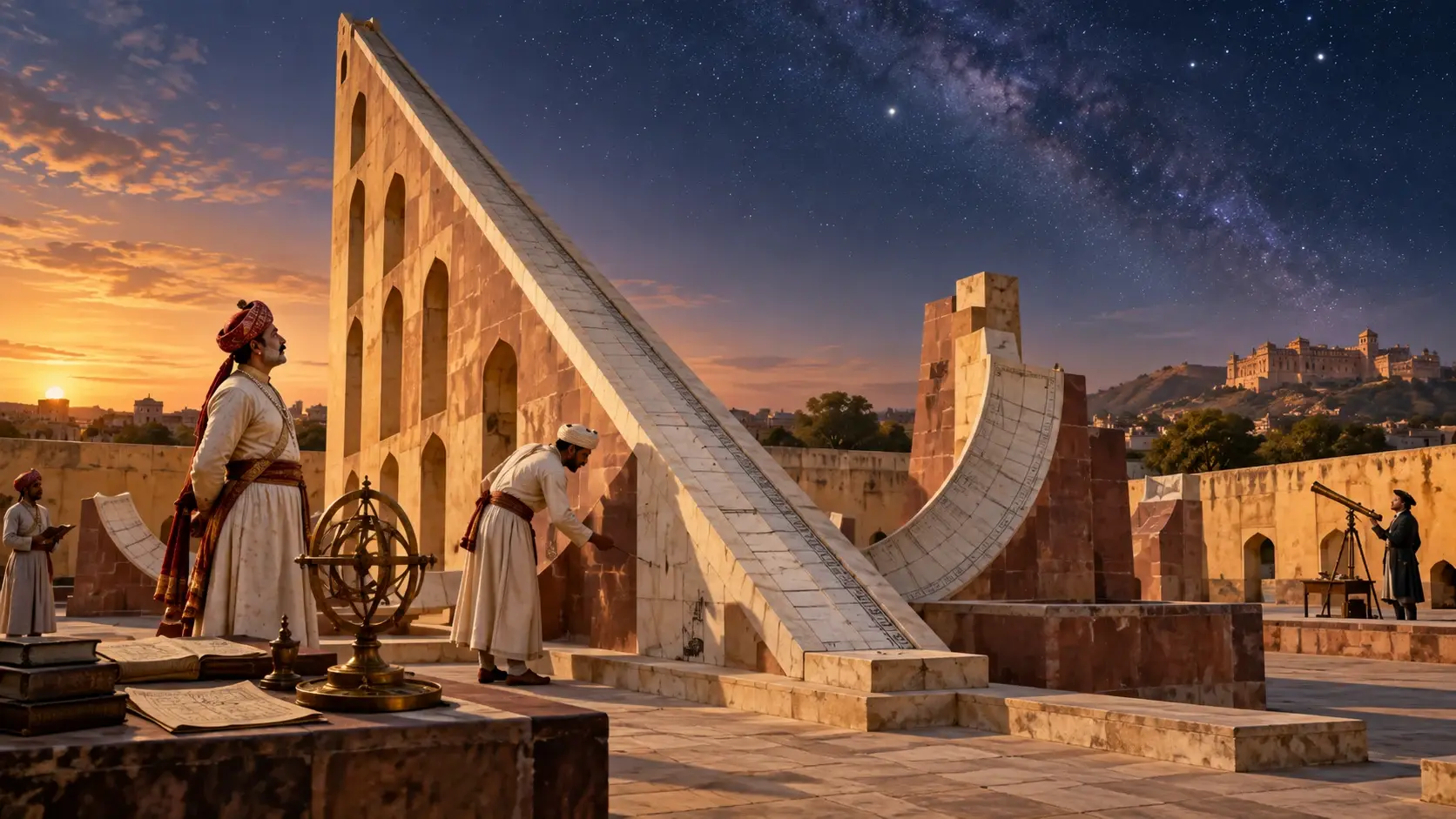
The monumental geometric masonry gnomons and quadrants of the Jantar Mantar at Jaipur.Archaeological Archives
Atop the sacred Sivagiri hill in Palani, Tamil Nadu, stands an ancient idol crafted not from stone or bronze, but from Navapashanam—an alchemical matrix of nine deadly poisons solidified by Sage Bogar. Discover the hidden chemistry, the healing powers of the overnight sandal paste and abhishekam prasadam, the subterranean tunnel connecting Bogar's samadhi, and the controversial 2004 replacement that triggered an international antiquities investigation.
High in eastern Turkey’s Tendürek Mountains, a 515-foot boat-shaped formation has puzzled researchers for 65 years. In September 2026, university archaeologists began direct core drilling for the first time since 1988. Discover what was actually recovered, how Collins and Fasold exposed early claims, and the falsifiable test awaiting 2027 lab results.
Coorg's hillside resorts book out months in advance now. Gokarna's main beach can feel more like a queue than a shoreline, and Hampi comes with tour buses in equal measure. But Karnataka's Malnad hill country and coastal belt hold a genuinely different kind of trip: rainforest instead of resort, empty tide lines instead of beach shacks, and moss-draped forts you'll have mostly to yourself. Discover 7 secret places in Karnataka that redefine South Indian travel.
In the early eighteenth century, at a time when European astronomers were increasingly turning toward telescopes, an Indian ruler took a strikingly different approach: Sawai Jai Singh II of Jaipur built astronomy into architecture.
Across five observatories in Delhi, Jaipur, Ujjain, Varanasi and Mathura, Jai Singh commissioned enormous fixed instruments made primarily from masonry. Their arcs, walls, gnomons and carefully aligned surfaces transformed astronomical geometry into monumental architecture.
The most spectacular was the Jantar Mantar at Jaipur, where the giant Brihat Samrat Yantra rises roughly 27 metres and functions as an enormous equinoctial sundial. UNESCO describes the Jaipur observatory as a monumental culmination of the tradition of naked-eye positional astronomy, with some instruments among the largest ever built in their categories.
An Astronomer-King in the Age of Telescopes
Sawai Jai Singh II was born in 1686 and became ruler of Amber at a time when the Mughal Empire was still the dominant political power in northern India. By the beginning of the eighteenth century, telescopes had already been used in Europe for more than a century. So Jai Singh's observatories were not built in an age before the telescope—they were built alongside the developing optical astronomy of Europe.
Jai Singh and his astronomers worked within a long tradition of positional astronomy derived from Indian, Islamic, Persian and earlier Greek traditions. UNESCO specifically identifies the Jaipur observatory as part of the broader tradition of positional astronomy, emphasizing the fruitful interaction of different scientific cultures at Jai Singh's court. His objective was not simply to see farther; it was to measure celestial positions accurately.
The Problem Was the Astronomical Tables
Astronomical tables were essential scientific tools for calculating planetary positions, timekeeping, eclipse predictions, and calendars. But Jai Singh discovered consistent discrepancies between calculated positions and direct sky observations.
Why Build an Observatory Out of Stone?
The answer was deceptively simple: **Scale creates measurable geometry.** Imagine trying to divide a small handheld circular instrument into extremely fine angular intervals—a tiny error in the pointer or pivot becomes glaring. Now enlarge the entire instrument: a small angular interval corresponds to a physical distance of several centimetres along the instrument's arc. The architecture was not decoration surrounding the science; the architecture was the scientific instrument.
Zij-i-Muhammad Shahi (dedicated to Emperor Muhammad Shah)
The Samrat Yantra: Turning a Building Into a Clock
The most famous example is the Samrat Yantra ("Supreme Instrument"). At Jaipur, its massive triangular gnomon rises about 27 metres, tilted precisely at Jaipur's latitude (26°55' N) to point toward the celestial pole. On either side are sweeping marble-faced quadrants that allow the position of the shadow to indicate local solar time.
A two-second graduation does not mean every observation is automatically accurate to two seconds. Penumbra blur caused by the Sun's 32-arcminute disc, atmospheric refraction, and observer alignment affect practical readings. The true achievement is that Jai Singh created a scale large enough for fine divisions of astronomical measurement to be physically legible without gears.
Stone Versus Telescope: A Misleading Rivalry
The popular claim that Jai Singh's stone instruments "outmeasured telescopes" oversimplifies their relationship. Telescopes and masonry instruments performed fundamentally different tasks. Optical telescopes magnified distant celestial surfaces, while Jai Singh's fixed instruments were designed for positional astronomy: determining celestial coordinates, altitudes, azimuths, and solar transit times.
Comparing Observational Paradigms in the Early 18th Century
Jai Singh’s Monumental Masonry Instruments
Primary Function:Positional astronomy and solar/planetary coordinate mapping.
Sighting Methodology:Naked-eye sighting through sighting pins and geometric shadow edges.
Physical Stability:Immovable stone foundations anchored to ground; zero tremor.
Optical Aberrations:Completely free from chromatic and spherical optical distortions.
Observational Limits:Unable to resolve faint stars, planetary rings, or deep nebulae.
Early European Optical Telescopes
Primary Function:Optical magnification of celestial surfaces, lunar craters, and moons.
Sighting Methodology:Glass lens magnification through a narrow field of view.
Physical Stability:Handheld or early wooden tripod mounts prone to vibration.
Optical Aberrations:Subject to severe chromatic fringing and lens imperfections.
Observational Limits:Opened new frontiers of deep space and planetary discovery.
The Observatory as an Open-Air Laboratory
The Samrat Yantra is only one part of the story. Jai Singh's observatories contained diverse instrument types designed for specialized geometric measurements.
Key Architectural Astronomical Instruments of the Jantar Mantar Network
Instrument Name
Architectural Form
Astronomical Function
Samrat Yantra
Triangular gnomon with bilateral curved quadrants
Equinoctial sundial for local solar time, declination, and meridian passage.
Jai Prakash Yantra
Complementary sunken hemispherical marble bowls
Mapping coordinates directly onto the inverted celestial sphere.
Rama Yantra
Open-topped cylindrical pillars with graduated stone slats
Direct measurement of altitude and azimuth of celestial objects.
Digamsa Yantra
Concentric circular walls with a central pillar
Precise measurement of azimuthal compass bearings.
Rashivalaya Yantra
Set of 12 separate instruments tilted to each zodiac sign
Direct measurement of celestial latitude and longitude in ecliptic coordinates.
Nadivalaya Yantra
Dual-faced circular stone plates aligned to celestial equator
Determining solar equinoxes and northern/southern hemisphere solar transit.
Jai Prakash: The Sky Turned Inside Out
One of the most visually extraordinary instruments is the **Jai Prakash Yantra**. It consists of two sunken hemispherical marble bowls marked with inverted celestial coordinates. Crosswires stretched across the top cast a shadow into the bowl, allowing astronomers to read the exact altitude, azimuth, and zodiacal sign of celestial bodies.
Sources of Error: Stone and Glass Alike
It would be inaccurate to depict the masonry instruments as flawless. Large scale solved vibrational instability but introduced masonry settling, plaster weathering, marble expansion, and calibration drift over decades. UNESCO specifically notes that maintenance and restoration over the centuries have affected graduations and authenticity.
Meanwhile, European optics advanced rapidly. With the invention of achromatic doublet lenses, micrometer eyepieces, and precision pendulum clocks, optical observatories quickly surpassed naked-eye masonry in resolving power and portability. Jai Singh's observatories represented the ultimate peak of one technological lineage, just as another was transforming astronomy.
Five Observatories: An Empire-Wide Scientific Network
Jai Singh constructed a network of five observatories across North India: **Delhi (1724)**, **Jaipur (1734)**, **Ujjain** (the Greenwich of classical Indian astronomy), **Varanasi**, and **Mathura**. Simultaneous observations across different latitudes allowed cross-verification of astronomical events.
This observational programme produced the **Zij-i-Muhammad Shahi**, a landmark astronomical ephemeris dedicated to Mughal Emperor Muhammad Shah that synthesized centuries of Persian, Indian, and contemporary European observations.
Chronology of Sawai Jai Singh’s Astronomical Enterprise
1686 CE
Birth of Sawai Jai Singh II
Born into the Kachhwaha Rajput royal house; ascends the throne of Amber and masters Sanskrit, Persian, and mathematical texts.
1719–1724 CE
Astronomical Reforms & Delhi Observatory
Tasked by Emperor Muhammad Shah with revising planetary tables; designs and builds the first monumental observatory at Delhi.
1727–1734 CE
Founding of Jaipur & Brihat Samrat Yantra
Establishes his new capital Jaipur and constructs the largest Jantar Mantar, featuring the 27-metre-tall Brihat Samrat Yantra.
1735 CE
Publication of the Zij-i-Muhammad Shahi
Publishes updated astronomical tables synthesizing Ulugh Beg's catalogue, Sanskrit treatises, and French astronomical tables.
1743 CE
Passing of the Astronomer-King
Death of Jai Singh; the Jaipur observatory remains active under court astronomers into the early 19th century.
2010 CE
UNESCO World Heritage Inscription
Jaipur’s Jantar Mantar is inscribed on the World Heritage List as a monumental culmination of positional astronomy.
Editorial Fact-Check: What Can Actually Be Claimed?
Historical Fact-Check: Jantar Mantar Myths vs. Documented Evidence
Popular Claim
Historical & Scientific Assessment
Verdict
Jai Singh rejected telescopes out of ignorance
Jai Singh owned telescopes, consulted Jesuit astronomers, and studied European tables.
False
The Samrat Yantra measures time to exactly 2 seconds
Its marble scales are graduated to 2-second intervals; optical blur and solar diameter make practical precision ~10–15 seconds.
Nuanced Reality
Stone instruments permanently defeated telescopes
Stone provided superior mechanical stability for naked-eye position mapping; optical astronomy quickly surpassed naked-eye resolution.
False Equivalence
Jantar Mantar was an isolated Hindu astrological site
It was a cosmopolitan scientific project synthesizing Sanskrit, Persian (Ulugh Beg), and French (de La Hire) astronomy.
Historically Proven
Five observatories were constructed across India
Delhi, Jaipur, Ujjain, Varanasi, and Mathura (the Mathura site was destroyed in the 1850s).
Historical Fact
Conclusion: When Architecture Became an Astronomical Instrument
Sawai Jai Singh II lived during a remarkable transitional period. The old world of naked-eye astronomy had not disappeared; the new world of telescopes had not yet reached its full potential. Between them stood the monumental observatories of the Jantar Mantar.
“At Jaipur, the movement of the heavens was translated into stone. For a brief period in the eighteenth century, one of the world's most ambitious astronomical instruments was a building large enough to measure the sky.”
Beyond Bharat Editorial Team — Positional Astronomy in the Age of Transition
Scholarly Frequently Asked Questions
Why did Sawai Jai Singh build observatories out of stone instead of using telescopes?▼
Jai Singh had access to early telescopes and brass astrolabes, but found that small instruments suffered from mechanical vibration, thermal distortion, and reading error on tiny graduated circles. By magnifying the instruments to architectural scale in immovable masonry, tiny angular differences in the sky were stretched across metres of physical stone, allowing precise positional measurements.
Can the Samrat Yantra really measure time down to two seconds?▼
The Jaipur Samrat Yantra's curved marble quadrants are graduated in two-second intervals. However, because the Sun is an extended disc of about 32 arcminutes rather than a point source, the shadow edge creates a blurred penumbra. In practice, skilled observers could read time to within roughly 10–15 seconds under clear daylight.
Did Jai Singh communicate with European astronomers?▼
Yes. Jai Singh sent scholarly delegations to Europe and hosted Jesuit astronomer-priests (such as Father Emmanuel de Figueiredo) in Jaipur. He acquired European astronomical tables, notably those of French astronomer Philippe de La Hire, and translated Euclid's Elements and Napier's work on logarithms into Sanskrit.
Where are the five Jantar Mantar observatories located?▼
Sawai Jai Singh constructed five observatories: Delhi (1724), Jaipur (1734), Ujjain, Varanasi, and Mathura. Jaipur is the largest and best preserved. The Mathura observatory was dismantled in the mid-19th century, but the remaining four survive today.