The Maritime Thalassocracy: How the Cholas Projected Power Across the Bay of Bengal
How Rajaraja Chola I and Rajendra Chola I transformed the Chola state into a major maritime power linking South India, Southeast Asia and the wider Indian Ocean world.
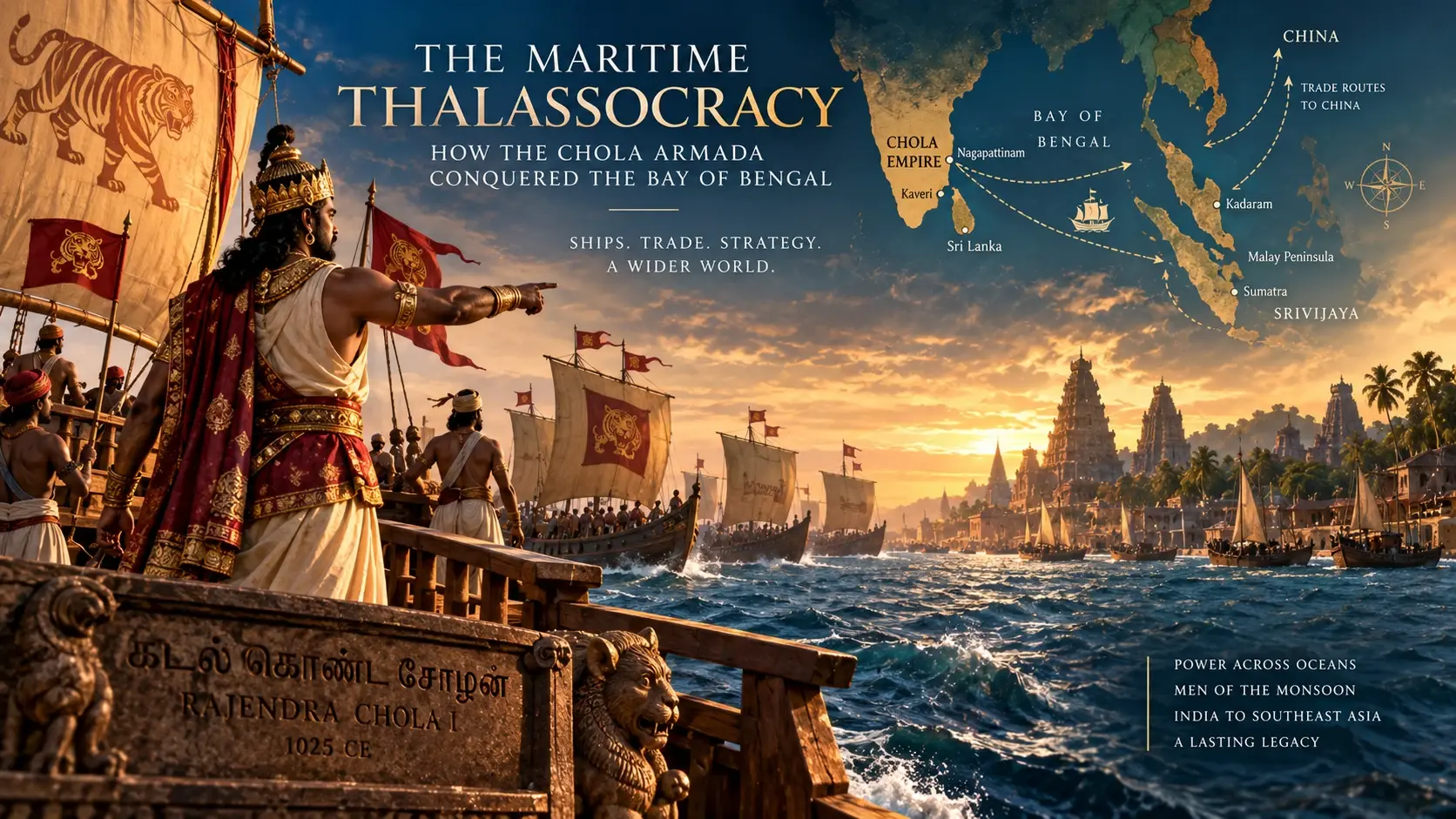
In the 11th century, the Chola Empire developed an extraordinary capacity for maritime warfare and commerce. Rajendra Chola I's 1025 expedition against Srivijaya sent Chola forces across the Bay of Bengal, striking a chain of Southeast Asian centres and demonstrating the reach of South India's most powerful imperial state.
Aakash Bhagat
Founder & Editor
•Updated September 9, 2026•15 min read
Naval expeditions across the Bay of Bengal and the Malacca Straits during the Chola Empire.Archaeological Archives
Atop the sacred Sivagiri hill in Palani, Tamil Nadu, stands an ancient idol crafted not from stone or bronze, but from Navapashanam—an alchemical matrix of nine deadly poisons solidified by Sage Bogar. Discover the hidden chemistry, the healing powers of the overnight sandal paste and abhishekam prasadam, the subterranean tunnel connecting Bogar's samadhi, and the controversial 2004 replacement that triggered an international antiquities investigation.
High in eastern Turkey’s Tendürek Mountains, a 515-foot boat-shaped formation has puzzled researchers for 65 years. In September 2026, university archaeologists began direct core drilling for the first time since 1988. Discover what was actually recovered, how Collins and Fasold exposed early claims, and the falsifiable test awaiting 2027 lab results.
Coorg's hillside resorts book out months in advance now. Gokarna's main beach can feel more like a queue than a shoreline, and Hampi comes with tour buses in equal measure. But Karnataka's Malnad hill country and coastal belt hold a genuinely different kind of trip: rainforest instead of resort, empty tide lines instead of beach shacks, and moss-draped forts you'll have mostly to yourself. Discover 7 secret places in Karnataka that redefine South Indian travel.
In the eleventh century, the Chola Empire of southern India became one of the most important maritime powers in the Indian Ocean world. Under Rajaraja Chola I and his son Rajendra Chola I, the Chola state expanded across southern India and Sri Lanka, developed important connections with overseas trading networks, and launched one of the most remarkable naval expeditions in medieval Asian history.
In 1025 CE, Rajendra's forces crossed the Bay of Bengal and attacked the Srivijaya polity, striking a series of ports and political centres across Sumatra, the Malay Peninsula and nearby islands. A Chola inscription records the capture of Sangrama Vijayottungavarman, the ruler of Kadaram, along with the seizure of wealth and royal insignia.
The 1025 Chola Naval Projection at a Glance
Supreme Commander
Rajendra Chola I (r. 1014–1044 CE)
Primary Naval Haven
Nagapattinam, Coromandel Coast
Target Maritime Polity
Srivijaya (Sumatra, Malay Peninsula & Straits)
Adversary Monarch
Sangrama Vijayottungavarman of Kadaram (Captured)
Primary Epigraphic Record
Thanjavur Temple & Tirumalai Meykīrtti Praśastis
Target Network Extent
Srivijaya plus 12 coastal port centres across Southeast Asia
Strategic Character
Trans-oceanic punitive strike, commercial protection & imperial force projection
1. A Kingdom Facing Two Seas
The Chola heartland lay in the fertile Kaveri delta of Tamil Nadu, but the empire's geography gave it access to an enormous maritime world. Its eastern coastline opened directly onto the Bay of Bengal. This connected the Chola realm to Sri Lanka, the Maldives, the eastern Indian coast, the Bay of Bengal, the Malay Peninsula, Sumatra, Southeast Asian ports, and, through maritime trade networks, Song Dynasty China.
The Cholas therefore operated in a world where political power and commercial power were closely connected to the sea. But it would be misleading to imagine the Cholas as possessing a modern-style naval empire controlling every sea lane. The surviving evidence is much more specific: they possessed the ability to transport armies by sea, conduct amphibious warfare and mount long-distance naval expeditions.
2. Rajaraja Chola I: Building the Maritime Foundation
The maritime expansion associated with Rajendra Chola did not appear suddenly. His father, Rajaraja Chola I, had already transformed the Chola state into a major imperial power. During his reign, Chola armies conquered substantial parts of Sri Lanka, while Chola power extended southward into the Indian Ocean.
3. The Bay of Bengal Was a Commercial Highway
The Bay of Bengal was not an empty expanse separating India from Southeast Asia; it was one of the great maritime corridors of the medieval world. Seasonal monsoon winds made it possible for sailors to plan regular voyages between the Indian subcontinent and Southeast Asia. Merchants carried goods, religious ideas, languages and people along these routes.
Among the important South Indian commercial organizations were Manigramam and Ayyavole, along with other merchant associations such as Nanadesi and Anjuvannam. Epigraphic evidence shows that South Indian merchant guilds participated in both inland and overseas commerce and maintained connections extending into Southeast Asia and beyond.
4. Merchant Guilds and the Chola Commercial World
The Ayyavole and Manigramam guilds are particularly important for understanding this system. They were not simply modern-style companies. They were organized merchant associations with their own institutions, networks, armed retinues, and commercial interests.
Epigraphic research shows that merchant organizations operated across South India and maintained connections with overseas commercial centres. Some inscriptions from Southeast Asia provide direct evidence of South Indian merchant activity beyond the subcontinent. A merchant could sail beyond the territorial limits of the Chola kingdom and interact with foreign rulers, ports and communities. This is why it is too simplistic to describe Chola overseas expansion as merely a military attempt to "control trade." The relationship between state power and merchant networks was far more nuanced.
5. The Cholas and Srivijaya
To understand the famous naval expedition of 1025, we need to understand Srivijaya. Srivijaya was a powerful maritime polity centred primarily on Sumatra, with influence over important parts of the Malay Peninsula and the maritime routes connecting the Indian Ocean with the South China Sea.
Its strategic importance came from geography. Ships travelling between India and China could pass through maritime zones controlled or influenced by Srivijayan centres. The polity was therefore deeply embedded in the commercial geography of Southeast Asia. And in the eleventh century, the Cholas possessed the naval capability to strike it.
6. Rajendra Chola's 1025 Expedition
The central evidence for the expedition comes from Chola inscriptions, particularly the royal meykīrtti or eulogistic record of Rajendra. The inscription describes Rajendra as having sent "many ships in the midst of the rolling sea" and then lists a series of places attacked during the campaign.
“Having sent many ships in the midst of the rolling sea and having caught Sangrama-Vijayottungavarman, the King of Kadaram, together with the elephants in his glorious army... Rajendra took the large heap of treasures, the Vidhyadhara-torana at the war-gate of his extensive city...”
Thanjavur Temple Praśasti Inscription — Reign of Rajendra Chola I (c. 1025–1030 CE)
Among the places named are Kadaram (Kedah), Srivijaya (Palembang), Pannai (Sumatran east coast), Malaiyur (Jambi), Ilamuridesam (Lamuri in northern Sumatra), and several other centres associated with Sumatra, the Malay Peninsula and surrounding islands. The inscription is unusually valuable because it provides evidence that the campaign was not simply a raid against one isolated port. It was a multi-target overseas expedition.
7. The Capture of the Srivijayan Ruler
One of the most striking claims in the inscription concerns Sangrama Vijayottungavarman, identified as the ruler of Kadaram. The Chola record says that Rajendra's forces captured him and seized his wealth and royal possessions. This is one reason the expedition became so famous: a South Indian ruler had projected military power across the Bay of Bengal and struck the political centres of another major maritime power.
Yet there is an important qualification. The Chola inscription is a royal victory inscription. Its purpose was to celebrate the king's achievements. Therefore, historians use it as primary evidence while also treating its courtly rhetoric carefully.
8. Did Rajendra Conquer Srivijaya?
Not in the sense of establishing a permanent Chola province across Sumatra and the Malay Peninsula. This is one of the most important corrections to the popular story. The expedition appears to have been a military raid or punitive campaign of exceptional scale, rather than a permanent territorial conquest of Southeast Asia.
9. Why Would the Cholas Attack Srivijaya?
Historians have proposed several interacting explanations: 1) Commercial competition: political developments within Srivijaya may have interfered with South Indian merchant interests along the Malacca Straits; 2) Strategic competition: both were major naval powers in overlapping maritime networks; 3) Royal prestige: medieval Indian kingship prioritized universal conquest (digvijaya); and 4) Plunder: the acquisition of vast royal treasuries. In the absence of a surviving strategic manifesto from Rajendra, a combination of these motives remains the safest scholarly interpretation.
10. The Chola Navy: What Do We Actually Know?
This is where popular accounts often become speculative. Descriptions of the Chola navy sometimes claim that it possessed multi-deck warships, specialized attack vessels, enormous transport ships, standardized naval classes, and sophisticated incendiary weapons. The problem is that the surviving evidence does not allow us to reconstruct the Chola fleet with that level of certainty.
Cambridge's scholarly overview of the Chola navy explicitly notes that we have very little contemporary evidence for the organization of the navy, the number of ships, their detailed design, the size of the forces or the locations of naval bases. Therefore, claims about precise ship classes or fleet architecture should be treated cautiously.
11. What Kind of Ships Did They Use?
The Cholas obviously required vessels capable of transporting soldiers and supplies. Their earlier campaigns in Sri Lanka demonstrate that Chola forces could move substantial military forces across maritime distances. The 1025 expedition demonstrates an even greater capability.
But we do not possess a surviving Chola naval manual giving us specifications such as: length × beam × number of decks × crew × armament. That information simply does not survive. Instead, historians reconstruct the naval system indirectly through inscriptions, port archaeology, literary references, merchant inscriptions, foreign records, and comparative evidence from Indian Ocean sailing traditions.
12. What About "Greek Fire"?
The claim that Chola warships used a weapon equivalent to Greek fire is especially difficult to substantiate. There is no sufficiently strong contemporary evidence demonstrating that the Chola navy routinely used a standardized incendiary weapon equivalent to Byzantine Greek fire. Ancient and medieval warfare certainly used fire-based weapons like pitch pots and incendiary arrows in many regions, but that does not establish a Chola naval arsenal of specialized pressurized liquid-fire projectiles. For a research-oriented history article, the claim should therefore be discarded.
13. The 3,000-Kilometre Crossing
The popular story often says that Rajendra's fleet crossed 3,000 kilometres of open ocean. The underlying point is reasonable: the expedition involved long-distance maritime movement. But the exact distance depends on the departure port, the route, the sequence of targets, and the definition of "crossing." Contemporary Chola inscriptions do not provide a mileage figure. What can be said confidently is that the expedition crossed the Bay of Bengal and operated across a very large maritime theatre extending from the Indian subcontinent toward Sumatra and the Malay Peninsula.
14. A Network of Targets, Not One Battle
One of the most remarkable features of the expedition is the number of locations named in Rajendra's inscription. This was not simply: Chola fleet → Srivijaya capital → victory → return. The inscription records attacks on a series of places: Srivijaya plus twelve other port cities or territories in the Malay Peninsula, Sumatra and the Nicobar region. That pattern suggests a campaign designed to strike an entire maritime network rather than simply capture one city.
15. The Bay of Bengal as a Strategic Theatre
The expedition demonstrates something important about medieval Indian Ocean politics: the sea was not simply a commercial highway; it was also a strategic space. A ruler who could move troops across it could threaten foreign ports, protect commercial interests, attack rival political centres, disrupt maritime networks, and demonstrate imperial prestige. The Cholas therefore treated the Bay of Bengal as a space that could be crossed, contested and militarized.
16. The Chola–China Connection
During the eleventh century, the Cholas maintained diplomatic and commercial relations with the Song dynasty. Chinese records refer to the Chola kingdom, and maritime trade connected South India with the wider South China Sea world. But we should be careful about one popular claim: "Rajendra conquered Srivijaya and thereby opened unrestricted trade with Song China." Trade existed before and after the 1025 expedition; the conflict should be understood within a larger, pre-existing commercial network.
17. Nagapattinam: A Port at the Heart of the Network
The Chola maritime world depended on ports. One of the most important was Nagapattinam on the Tamil coast. Its location connected the Kaveri region to the Bay of Bengal's wider maritime system. Nagapattinam was also associated with Buddhist connections to Southeast Asia (including the royal Chudamani Vihara endowed by Srivijaya's kings) and with diplomatic and commercial interactions extending across the Bay of Bengal.
18. Merchant Guilds Were the Other Half of the System
Military power alone does not explain the Chola maritime world. The merchant guilds matter enormously. Organizations such as Manigramam and Ayyavole created durable commercial networks that connected inland production centres with ports and overseas markets.
19. The Chola Empire Was Not a Colonial Empire in the Modern Sense
The word "thalassocracy" is useful, but it should not be misunderstood. A thalassocracy generally refers to a state whose power is strongly associated with maritime control. The Cholas certainly demonstrated significant maritime power. But they did not establish a modern colonial empire stretching continuously across Southeast Asia. After the 1025 expedition, Srivijayan and Southeast Asian political structures continued to exist. Terms such as "maritime projection of imperial power" are far more historically accurate.
20. The "Chola Lake" Was a Metaphor, Not a Map
The phrase "Chola Lake" is evocative, but it should not be interpreted literally. The Bay of Bengal remained a shared maritime world involving Chola India, Srivijaya, Southeast Asian states, Arab and Persian merchants, Chinese traders, and many smaller coastal communities. The Cholas did not exercise continuous naval sovereignty over the entire bay. Their achievement was instead that they could project military power across it on an unprecedented scale for an Indian kingdom.
Rigorous Epigraphic History vs. Popular Romanticized Lore
Empirical Historical Evidence
Territorial Governance:Trans-oceanic force projection & tributary raid; local Southeast Asian rulers retained autonomy
Naval Technology:Sewn-plank timber transports timed precisely to seasonal monsoon winds
Naval Armaments:Composite archery, javelins, boarding swords, and incendiary pitch pots
Commercial System:Independent corporate merchant guilds (Ayyavole, Manigramam) operating across borders
The "Chola Lake":A literary metaphor for unprecedented oceanic strike capability
Popular Romanticized Lore
Territorial Governance:Direct colonial annexation with standing provincial Chola administrators
Naval Technology:Standardized multi-decked galleons with metal ramming prows
Naval Armaments:Pressurized siphon Greek Fire and naval artillery
Commercial System:State-monopolized trade enforcing closed Chola commercial exclusivity
The "Chola Lake":A closed sovereign lake patrolled 24/7 by standing naval squadrons
21. What Happened After the 1025 Raid?
The Chola–Srivijaya relationship did not simply become one of permanent warfare. South Indian and Southeast Asian connections continued through commerce, religion and diplomacy. The evidence suggests that warfare and commerce could coexist: medieval states could fight one another while merchants continued operating across the same broad oceanic networks.
22. Did the Cholas Spread Hinduism Across Southeast Asia?
This claim also needs qualification. Indian religious and cultural influence in Southeast Asia was already centuries older than the Chola Empire. Sanskrit inscriptions, Hindu and Buddhist traditions, Indic political concepts and Indian artistic forms had spread through complex processes involving merchants, religious specialists, local rulers and cultural exchange. The Cholas participated in this world; they did not create it.
23. The Angkor Wat Connection
A common popular claim says: "Chola influence can be seen in Angkor Wat." However, Angkor Wat was a Khmer achievement, built under King Suryavarman II in the early twelfth century. It should not be presented as a Chola-built or directly Chola-derived monument. The Khmer civilization developed its own distinctive architectural traditions while participating in a much older Indianized cultural world.
24. The Chola Contribution Was Part of a Larger Maritime Civilization
The most accurate picture is therefore not: "India conquered Southeast Asia and imposed its culture." It is: Indian Ocean societies interacted through trade, migration, religion, diplomacy and warfare, producing interconnected but locally distinctive civilizations. The Cholas were one of the most powerful participants in that system.
25. Why the 1025 Expedition Matters
The 1025 expedition matters because it demonstrates something that is easy to underestimate: a medieval South Indian state possessed the organizational capacity to launch a coordinated military expedition across one of the world's largest maritime spaces. The expedition required ships, soldiers, provisions, navigation, knowledge of monsoon routes, command structures, coastal logistics, and a political system capable of financing long-distance warfare.
26. The Naval Achievement Was More Than Ships
It is tempting to focus on the word "armada." But the deeper achievement was institutional. A naval expedition requires an ecosystem: agricultural surplus → tax revenue → craft production → ports and merchant communities → ships and maritime expertise → military manpower → long-distance logistics → overseas intelligence and navigation. The expedition therefore reveals something profound about the capacity of the Chola state itself.
27. What Makes the Chola Maritime Story Extraordinary?
Not the claim that they "ruled the oceans." Not the idea that they possessed mysterious super-ships or Greek fire. The real achievement is that around the beginning of the eleventh century, the Chola state had developed enough political, economic and military capacity to dominate southern India, campaign in Sri Lanka, operate in the Maldives, maintain major coastal ports, support long-distance merchant networks, and launch a naval expedition against major political centres in Southeast Asia. That is already an extraordinary historical record.
Chronology of Chola Maritime Expansion & Oceanic Diplomacy
985–1014 CE
Rajaraja Chola I & Oceanic Consolidation
Rajaraja unifies southern India, establishes fortified naval ports, annexes northern Sri Lanka (Mummudi-Chola-mandalam), and launches an amphibious campaign against the Maldives.
1014 CE
Accession of Rajendra Chola I
Rajendra accelerates maritime infrastructure, consolidates coastal merchant guilds, and founds Gangaikonda Cholapuram as the monumental imperial capital.
1015 CE
First Chola Embassy to Song China
A diplomatic and trade mission dispatched by Rajaraja and Rajendra arrives at the Song imperial court in Kaifeng, establishing direct royal ties.
1025 CE
The Trans-Oceanic Srivijaya Expedition
Rajendra dispatches an imperial fleet across the Bay of Bengal, capturing King Sangrama Vijayottungavarman of Kadaram and raiding 13 fortified ports across Sumatra and the Malay Peninsula.
1028–1033 CE
Trade Normalization & Follow-up Missions
Commercial ties resume across the Malacca Straits; Chola trade delegations return to China with exotic Southeast Asian and Indian goods.
1068–1070 CE
Virarajendra’s Intervention in Kadaram
Chola inscriptions record King Virarajendra dispatching a naval fleet to Kadaram to assist an allied prince to the throne, confirming enduring oceanic reach.
1077 CE
Grand Chola Embassy to Emperor Shenzong
A commercial and diplomatic mission under Kulottunga Chola I consisting of 72 delegates delivers tribute to Song Emperor Shenzong, yielding 81,800 strings of copper cash.
Comprehensive Scholarly Evaluation of Chola Naval Claims
Popular Historical Claim
Evidence-Based Scholarly Assessment
The Cholas were a major maritime power
Strongly supported
Rajaraja I laid important foundations for Chola maritime expansion
Supported
Rajendra I launched a major overseas expedition in 1025
Strongly supported
The expedition targeted Srivijaya and other Southeast Asian centres
Strongly supported by Chola inscriptions
Rajendra captured the Srivijayan/Kadaram ruler
Recorded in the Chola inscription; interpretation of titles and political identity requires care
The fleet crossed the Bay of Bengal
Strongly supported
The expedition covered exactly 3,000 km
Not established by contemporary evidence
The Cholas attacked 14 ports
Often stated, but the inscription’s enumeration is better described as Srivijaya plus twelve other named places
The Cholas permanently conquered Srivijaya
False / unsupported
The expedition permanently annexed Southeast Asia
False
The Cholas controlled the entire Bay of Bengal
Too strong / inaccurate
"Chola Lake" accurately describes literal political control
Metaphorical, not literal
Chola ships were multi-decked warships of known standardized classes
Insufficient evidence
Chola ships used Greek-fire-like liquid weapons
Unsupported
Merchant guilds such as Manigramam and Ayyavole were important to overseas commerce
Strongly supported
The 1025 campaign was definitely caused by trade restrictions
Possible interpretation, not proven
The campaign opened unrestricted trade with Song China
Unsupported as a direct causal claim
Cholas created Indian cultural influence in Southeast Asia
Too simplistic — Indic cultural exchange predates the Cholas by centuries
Angkor Wat was a result of Chola conquest
False
The Chola maritime network connected India with Southeast Asia and China
Strongly supported
Conclusion: The Sea Became an Imperial Frontier
The Chola achievement was not that a South Indian king somehow "conquered the ocean." The sea cannot be conquered in that sense. What the Cholas demonstrated was something more practical—and historically more significant: they learned to use the sea as an extension of imperial power.
Rajaraja Chola I established the foundations through territorial expansion, Sri Lankan campaigns and Indian Ocean operations. Rajendra Chola I pushed that capability dramatically farther. In 1025, Chola forces crossed the Bay of Bengal and struck a chain of Srivijayan centres, capturing a ruler, seizing wealth and announcing that a South Indian empire could project military power deep into Southeast Asian waters.
At the same time, merchant guilds such as Manigramam and Ayyavole were creating commercial networks that stretched far beyond the Chola homeland. The result was not a conventional overseas colony, but an empire connected by ships, merchants, monsoon winds, ports and military power.
“The Cholas did not own the Bay of Bengal. But in the eleventh century, they proved that they could cross it, fight across it and project the power of their kingdom far beyond India's shores.”
Beyond Bharat Editorial Team — Maritime History Synthesis
Scholarly Frequently Asked Questions
Did Rajendra Chola permanently annex Sumatra and Malaysia?▼
No. The 1025 expedition was a punitive military raid of exceptional magnitude rather than a territorial conquest. Srivijayan rulers resumed governance, and no Chola administrative bureaucracy or permanent garrisons were established.
Did the Chola navy employ liquid Greek Fire?▼
There is no contemporary epigraphic, archaeological, or literary evidence for the use of pressurized liquid petroleum weapons in the Chola fleet. While combustible arrows and pitch pots were used, Byzantine-style siphon fire is unsupported.
Why is the phrase "Chola Lake" considered a metaphor?▼
The Bay of Bengal was a shared oceanic highway traversed by Arab dhows, Persian merchants, Srivijayan navigators, and Chinese junks. The Cholas projected force across it, but did not exercise closed sovereign territorial control.
What was the relationship between merchant guilds and the Chola state?▼
Merchant guilds like Ayyavole and Manigramam were autonomous corporate bodies with their own armed escorts. They financed trade, supplied intelligence, and benefited from royal naval protection, forming a cooperative commercial ecosystem.
Did the Cholas build Angkor Wat in Cambodia?▼
No. Angkor Wat was designed and built in the early 12th century under Khmer King Suryavarman II. While reflecting pan-Indic Hindu and Sanskrit traditions, it was entirely an achievement of Khmer civilization.
Related Dispatches on Ancient Technology & History