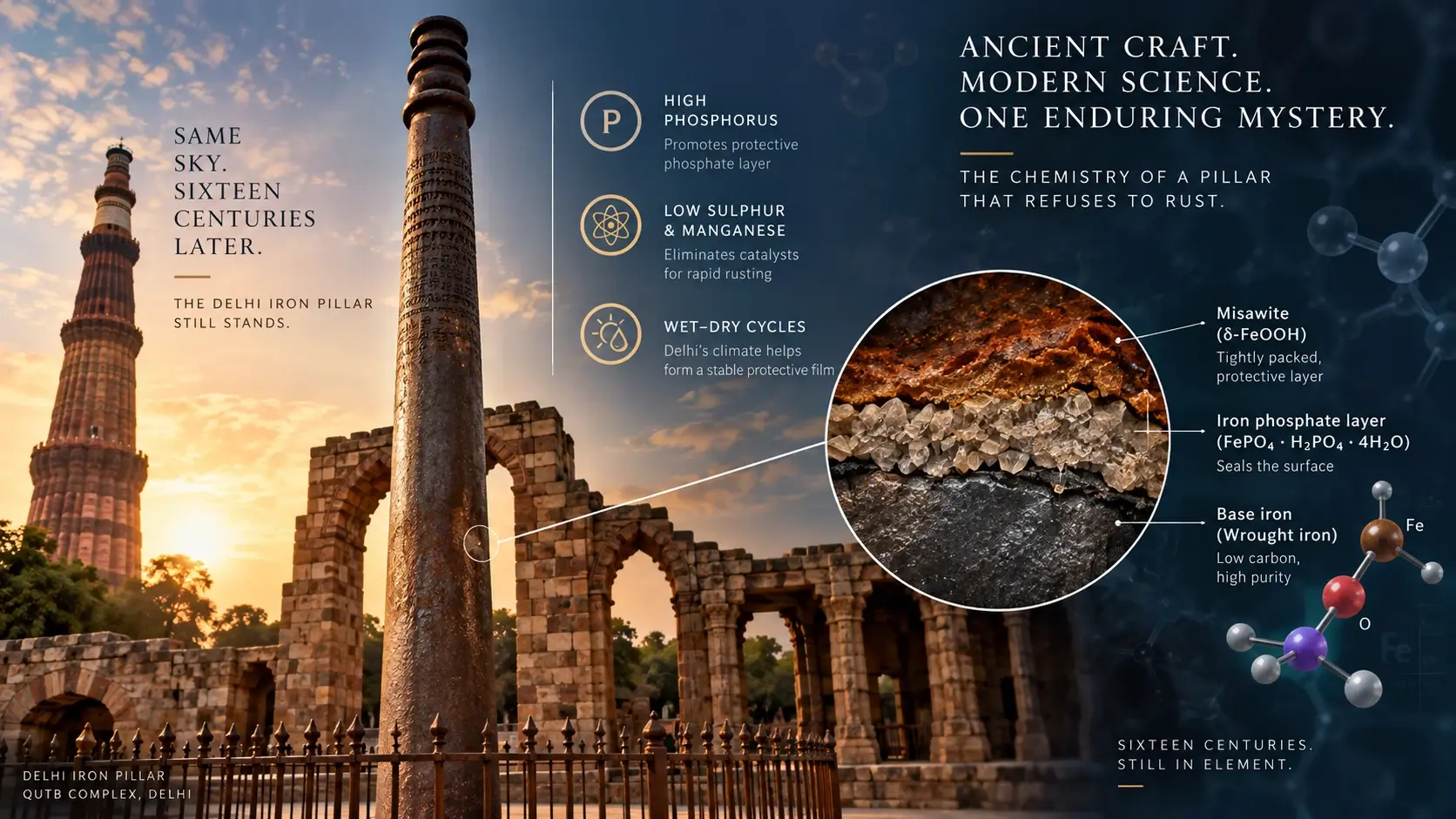
The 1,600-Year Corrosion Riddle: The Chemistry of the Delhi Iron Pillar
How Gupta-era ironworking, phosphorus-rich wrought iron and a remarkable protective corrosion layer helped the Delhi Iron Pillar survive for more than 1,600 years.
Standing more than seven metres tall in Delhi's Qutb Complex, the Gupta-era Iron Pillar has survived for over 1,600 years with remarkably little atmospheric corrosion. Modern metallurgical studies reveal that its unusual phosphorus-rich wrought iron, slag inclusions, forge-welded structure and protective phosphate and iron oxyhydroxide layers work together to slow rusting.
Aakash Bhagat
Founder & Editor
•Updated September 9, 2026•14 min read
The 1,600-year-old Gupta-era wrought iron pillar at the Qutb Complex in Mehrauli, Delhi.Archaeological Archives
Atop the sacred Sivagiri hill in Palani, Tamil Nadu, stands an ancient idol crafted not from stone or bronze, but from Navapashanam—an alchemical matrix of nine deadly poisons solidified by Sage Bogar. Discover the hidden chemistry, the healing powers of the overnight sandal paste and abhishekam prasadam, the subterranean tunnel connecting Bogar's samadhi, and the controversial 2004 replacement that triggered an international antiquities investigation.
High in eastern Turkey’s Tendürek Mountains, a 515-foot boat-shaped formation has puzzled researchers for 65 years. In September 2026, university archaeologists began direct core drilling for the first time since 1988. Discover what was actually recovered, how Collins and Fasold exposed early claims, and the falsifiable test awaiting 2027 lab results.
Coorg's hillside resorts book out months in advance now. Gokarna's main beach can feel more like a queue than a shoreline, and Hampi comes with tour buses in equal measure. But Karnataka's Malnad hill country and coastal belt hold a genuinely different kind of trip: rainforest instead of resort, empty tide lines instead of beach shacks, and moss-draped forts you'll have mostly to yourself. Discover 7 secret places in Karnataka that redefine South Indian travel.
For more than sixteen centuries, a towering iron pillar has stood in Delhi with remarkably little visible corrosion. Located today within the Qutb Complex at Mehrauli, the Delhi Iron Pillar is about 7.2 metres long and weighs roughly six tonnes. Its Gupta-period Sanskrit inscription in Gupta script associates its erection with a king named Chandra, who is generally identified with Chandragupta II Vikramaditya.
The extraordinary part is not simply its age. It is the condition of the metal. The pillar has developed a protective corrosion layer rather than undergoing the continuous destructive rusting normally associated with exposed iron. Metallurgical investigations have shown that its unusual durability results from a combination of high phosphorus content, ancient wrought-iron production, entrapped slag, microstructure and Delhi's alternating wet-and-dry atmospheric conditions.
1. A Six-Tonne Iron Monument From the Gupta Age
The pillar's inscription is one of the most important pieces of evidence for its history. The Sanskrit inscription, written in classical Gupta-period script, describes a king named Chandra who established the pillar as a dhvaja, or standard, of Vishnu on a hill called Viṣṇupada. The king is generally identified by scholars with Chandragupta II Vikramaditya, whose reign falls in the late fourth and early fifth century CE.
The pillar itself is approximately 7.2 metres high, including the portion below ground, and weighs more than six tonnes. Metallurgical studies identify it as wrought iron, rather than cast iron. That distinction is important. The ancient smiths did not simply pour molten iron into a giant mould. They created a massive monolith through a laborious process of solid-state reduction, forging and forge welding.
Engineering & Metallurgical Profile: Delhi Iron Pillar
King Chandra (identified with Chandragupta II Vikramaditya, c. 375–415 CE)
2. First Correction: It Is Not Literally "Rustless"
The famous description of the Delhi Iron Pillar as "rustless" is useful as shorthand, but scientifically it is inaccurate. The pillar has corroded. Researchers have identified iron oxides, oxyhydroxides and phosphates in its corrosion products. The buried portion, in particular, has experienced substantially more corrosion than the exposed upper section. R. Balasubramaniam's research emphasizes that the pillar's exceptional resistance applies principally to the part exposed to the open atmosphere.
So the real mystery is not: Why did the pillar never rust? It is: Why did atmospheric corrosion slow dramatically instead of progressively consuming the exposed iron? That is a much more interesting question.
3. The Multi-Factor Metallurgical Explanation
Modern metallurgical research points toward several interacting factors rather than one magical ingredient. The chemistry of the metal and the atmospheric environment worked together in remarkable synergy.
Interacting Metallurgical and Environmental Factors in Corrosion Resistance
Factor
What Researchers Found
Why It Matters
High Phosphorus
The iron contains roughly 0.25% phosphorus in commonly cited compositional analyses
Promotes formation of protective phosphate and oxyhydroxide films directly at the metal-rust interface
Low Sulfur and Manganese
Both occur at very low levels compared with modern structural steels
Reflects ancient charcoal bloomery smelting and reduces unfavorable pitting pathways
Entrapped Slag Particles
Small slag particles remain finely dispersed within the wrought iron
Contributes to electrochemical conditions that help initiate rapid protective film formation
Wrought-Iron Microstructure
The pillar was assembled from forged blooms rather than poured cast iron
Produces a characteristic heterogeneous fibrous structure that impedes continuous corrosion propagation
Delhi Wet-Dry Cycles
Delhi's atmosphere repeatedly wets and dries the metallic surface
Helps transform unstable corrosion products into a more protective, stable crystalline layer
4. The Unusual Element: Phosphorus
The most important chemical clue is phosphorus. Analyses of the pillar have reported approximately 0.25% phosphorus, together with very low sulfur and manganese. The iron itself is relatively low in carbon and is predominantly iron. Modern metallurgists would not normally describe high phosphorus as universally beneficial. In many modern steels, phosphorus is carefully controlled (often below 0.05%) because excessive amounts can contribute to undesirable mechanical properties, particularly embrittlement.
But corrosion is a different problem. On the Delhi Iron Pillar, phosphorus participates in the formation of a protective surface chemistry. As the iron undergoes its initial atmospheric corrosion, phosphorus becomes enriched near the metal-rust interface. This helps promote the development of compact protective phases. The result is a remarkable feedback: corrosion begins → phosphorus becomes concentrated near the surface → protective corrosion products develop → subsequent corrosion slows. The rust itself becomes part of the defence.
5. The Strange Chemistry of "Rust That Protects Iron"
Ordinary rust is usually destructive because it is porous, poorly adherent and allows water and oxygen to continue reaching the underlying metal. But some corrosion products can form relatively dense protective layers. This is the key to the Delhi pillar.
Detailed X-ray diffraction, infrared spectroscopy and Mössbauer spectroscopy identified several corrosion products, including iron hydrogen phosphate hydrate, magnetite, goethite, lepidocrocite, δ-FeOOH, and other phosphates. The research showed that the protective corrosion system is not one single compound but a complex multilayered surface film. This is why the popular explanation that "one special chemical stopped the rust" is too simple. The pillar's surface chemistry is more sophisticated.
6. Misawite: Part of the Protective Film
One of the compounds identified in studies of the pillar is δ-FeOOH, an amorphous iron oxyhydroxide that is often called misawite in this literature. It is important to make one correction to the popular version of the story: misawite is not the entire protective shield.
Research on the Delhi Iron Pillar identifies δ-FeOOH as an important early protective phase, while the formation of a crystalline iron hydrogen phosphate hydrate at the metal–rust interface is described as particularly critical to the pillar's long-term corrosion resistance. The protective system is therefore better represented as: phosphorus-rich iron → initial corrosion → phosphorus enrichment → compact δ-FeOOH formation → phosphate formation → increasingly protective surface layer; rather than: phosphorus → misawite → no rust. That distinction makes the chemistry considerably more accurate.
7. The Phosphate Layer
The 2000 Corrosion Science study by Prof. R. Balasubramaniam identified crystalline iron hydrogen phosphate hydrate, represented chemically as FePO₄ · H₃PO₄ · 4H₂O, near the metal–oxide interface. The researchers concluded that this phosphate phase was particularly important because of its low porosity and its position immediately adjacent to the underlying metal.
Think of the process as the creation of a microscopic barrier. The iron surface does not remain exposed indefinitely. Instead, corrosion products progressively develop into a compact layer that makes it increasingly difficult for oxygen and moisture to continue attacking the metal beneath. The astonishing part is that the protection emerged through the corrosion process itself.
8. The Role of Slag: The "Impurity" That Helped
There is another apparent paradox. The pillar's iron contains slag inclusions. In ordinary circumstances, inclusions inside iron might be expected to create sites for localized corrosion. Yet in this particular material, research indicates that the slag played an important role in the development of the protective film.
The ancient smelting process left small quantities of slag and unreduced material embedded in the wrought iron. These inclusions created microscopic electrochemical cells when the metal first encountered atmospheric moisture. That initial corrosion helped enrich phosphorus at the surface. In simplified form: slag inclusions → initial electrochemical activity → phosphorus enrichment → protective film formation → reduced corrosion. An impurity therefore became part of the mechanism that ultimately protected the metal. This is one of the most fascinating aspects of the pillar's metallurgy.
9. Ancient Iron Was Made Without Modern Blast Furnaces
The Delhi Iron Pillar was not produced using modern blast-furnace technology. Ancient Indian ironworkers used a solid-state reduction process. Iron ore was reduced using charcoal, producing masses or blooms of wrought iron. These pieces could then be heated and hammered to remove some slag and consolidate the material.
The pillar represents the extraordinary extension of this technique to a monumental scale. Metallurgical studies conclude that there is no evidence that the pillar was made by melting and then solidifying the entire mass of iron. Instead, the material was assembled through forging and forge welding. That is an important distinction: the pillar was not a giant cast-iron object. It was a giant forge-welded wrought-iron structure.
10. How Do You Forge a Six-Tonne Pillar?
This is where ancient craftsmanship becomes extraordinary. Individual blooms or lumps of wrought iron could be heated until they became plastic and then hammered together. Repeated forging consolidated the iron, expelled some slag, shaped individual pieces, produced a characteristic fibrous structure, and allowed relatively small iron masses to become a much larger object.
The pillar's manufacture is therefore an example of forge welding at monumental scale. Modern studies of ancient Indian iron describe the pillar as having been assembled from multiple iron pieces through horizontal forge-welding techniques. The smiths did not need to melt six tonnes of iron. They needed to repeatedly heat, position, hammer and weld manageable masses of iron into one enormous structure. That was an entirely different technological challenge.
11. Was the Iron "Incredibly Pure"?
Another popular claim requires qualification. The pillar's iron is relatively pure in terms of its iron matrix and has low carbon compared with steel, but it is not chemically pure iron. It contains phosphorus, silicon, manganese, sulfur, carbon and other elements, along with slag inclusions. A representative composition reported in metallurgical literature is approximately: Carbon: 0.15%, Phosphorus: 0.25%, Sulfur: 0.005%, Silicon: 0.05%, Manganese: 0.05%, remainder predominantly iron. Actual composition varies depending on where and how a sample is analyzed. So "pure iron" is best understood as relatively pure wrought iron, not chemically pure Fe.
12. Why Didn't Delhi's Monsoon Destroy It?
Delhi experiences significant seasonal changes. The pillar has repeatedly encountered periods of moisture followed by drying. At first glance, this should seem disastrous for iron. Water encourages electrochemical corrosion. But in this case, alternating wetting and drying appears to have contributed to the transformation of the corrosion products into a more protective state. The 2000 Corrosion Science study specifically identified alternate wetting and drying cycles as important in the formation of the crystalline phosphate phase. This creates an important lesson: the environment was not simply the enemy. Under the pillar's particular chemical conditions, the environment helped create the protective layer.
13. Climate Alone Does Not Explain the Pillar
Older explanations sometimes emphasized Delhi's relatively dry atmospheric conditions. Climate does matter. But subsequent studies indicate that environmental conditions alone cannot explain the pillar's exceptional performance. Research comparing predicted corrosion behaviour with the pillar's actual condition suggests that the composition and microstructure of the iron are dominant factors, while Delhi's atmospheric environment contributes to the overall process. This is particularly interesting because ancient Indian iron objects with similar characteristics have demonstrated corrosion resistance in other environments as well. The chemistry of the metal therefore matters enormously.
14. The Pillar Is Not Immune to Corrosion
The evidence becomes even more compelling when we look at where corrosion actually occurred. The above-ground portion has survived remarkably well. But the buried section has suffered substantially more corrosion, including a rust layer and localized pitting. This tells us something fundamental: the pillar does not possess a supernatural immunity to corrosion. Its remarkable durability depends on specific atmospheric conditions and the formation of a protective surface film. Change the environment dramatically—especially by prolonged immersion or burial—and the protective advantage is greatly reduced.
15. The Protective Film Was Not Instantaneous
The pillar did not emerge from the forge with its modern protective surface already fully formed. The corrosion-resistance mechanism developed over time. Initial atmospheric exposure caused corrosion. That corrosion changed the chemistry of the surface. Phosphorus became enriched near the interface. Protective oxyhydroxide and phosphate phases developed. The corrosion rate then decreased. Balasubramaniam's work describes this as a process in which the initial corrosion period helps establish the passive film that subsequently protects the underlying iron. In other words: the pillar's resistance was partly created by the first stages of its own corrosion.
16. Did Ancient Smiths Intentionally Engineer the Phosphate Film?
This is where we must distinguish technological achievement from technological intention. The evidence demonstrates that ancient Indian ironworkers produced a material with a composition and microstructure exceptionally favourable to atmospheric corrosion resistance. But there is no surviving evidence showing that Gupta-period smiths understood the modern electrochemical mechanism in terms of phosphorus, δ-FeOOH or phosphate passivation.
We therefore should not say: "Ancient metallurgists deliberately designed a self-healing chemical coating." That goes beyond the evidence. A more defensible statement is: Ancient metallurgical practices unintentionally—or perhaps through accumulated practical experience—produced an iron composition and microstructure that developed exceptional atmospheric corrosion resistance. Their achievement does not become less impressive simply because we cannot prove that they understood the chemistry at the molecular level.
17. The "Self-Healing" Claim Needs Care
You will sometimes see the pillar described as having a "self-healing" protective coating. There is a useful idea behind this phrase, but it should not be taken literally. If the surface film is disturbed, fresh iron can certainly undergo corrosion and generate new corrosion products. But this is not the same thing as a modern engineered material autonomously repairing a mechanical crack. The more scientifically accurate description is: continued surface reactions can contribute to the ongoing development and maintenance of protective corrosion products under suitable atmospheric conditions. That is impressive enough without turning it into science fiction.
18. The Pillar's Manufacture Was an Engineering Achievement
The chemistry explains its corrosion resistance. The manufacturing process explains how such a massive iron object existed in the first place. The pillar demonstrates mastery of iron ore reduction, bloom production, charcoal-based smelting, hot forging, slag management, forge welding, large-scale assembly, surface finishing, and monumental metalworking. Modern studies describe the pillar as evidence of a highly developed ancient Indian tradition of wrought-iron production. It is particularly remarkable because the finished object is not merely a weapon or tool. It is a monumental architectural element made almost entirely from forged iron.
19. The Pillar's Original Location Remains an Important Historical Question
The pillar now stands at the Qutb Complex, but it was probably not originally erected there. Its Gupta inscription associates it with a place called Viṣṇupada-giri. A prominent scholarly interpretation places its original setting at Udayagiri in present-day Madhya Pradesh, an important Gupta-period religious and political centre associated with Chandragupta II and Vishnu worship. This reconstruction has been developed in detail by R. Balasubramaniam and later discussed by Michael Willis. However, the precise history of its relocation remains a subject of scholarly discussion. The safest formulation is therefore: The pillar was probably relocated to Delhi from an earlier Gupta-period site; Udayagiri is the leading proposed original location. That is stronger than presenting the relocation story as completely settled.
Rigorous Metallurgical Science vs. Popular Myths
Scientific Metallurgical Findings
Corrosion Status:Has corroded to form a 50–100 micron passive layer; underground base shows significant rust and pitting
Iron Composition:Wrought iron containing 0.25% phosphorus, 0.15% carbon, and dispersed slag inclusions
Engineering Intent:Empirical mastery of bloomery smelting and forge-welding that naturally retained beneficial phosphorus
Fabrication Method:Solid-state bloomery reduction and horizontal forge welding of hundreds of plastic iron blooms
Popular Myths & Speculations
Corrosion Status:A magical "rustless" iron pillar that never experienced any oxidation
Iron Composition:Chemically pure 100% elemental iron or extraterrestrial/meteoritic alloy
Engineering Intent:Ancient smiths deliberately synthesized modern electrochemical nanocoatings
Fabrication Method:Cast in a gigantic single mould from liquid molten iron
20. Why the Pillar Matters Beyond Its Rust
The Delhi Iron Pillar is often presented as a "rustless mystery." But that description reduces a complex technological achievement to one spectacular property. Its real importance is broader. It demonstrates that ancient Indian metallurgists could produce large-scale wrought iron, controlled forging, forge welding, and durable architectural construction on a scale that remains impressive even by modern engineering standards. Its corrosion resistance then adds another layer to the story. The pillar did not merely survive. It developed a complex protective corrosion system that dramatically slowed further atmospheric attack.
21. Modern Materials Science Found an Ancient Answer
The most fascinating part of the story is perhaps the way modern science approached the pillar. Researchers did not simply look at its surface and guess why it survived. They analyzed corrosion products using techniques including X-ray diffraction (XRD), Fourier-transform infrared spectroscopy (FTIR), Mössbauer spectroscopy, and metallographic and microstructural analysis. These techniques revealed the chemical phases present in the corrosion layer and helped reconstruct the sequence by which the protective film developed. The "mystery" therefore did not disappear. It became chemistry.
22. The Science in One Diagram
Chronology of the Delhi Iron Pillar
c. 375–415 CE
Erection by Chandragupta II Vikramaditya
Forged from hundreds of bloomery iron blooms and erected as a standard (dhvaja) of Vishnu at Viṣṇupada (identified as Udayagiri, Madhya Pradesh).
c. 1050–1100 CE
Relocation to Lal Kot / Mehrauli
Transported to modern Delhi, traditionally attributed to the Tomara Rajput ruler Anangpal II upon founding the citadel of Lal Kot.
1192–1198 CE
Incorporation into the Qutb Complex
Positioned in the central courtyard of the Quwwat-ul-Islam mosque under the early Delhi Sultanate, where it has stood for over 800 years.
1871 CE
First Systematic Archaeological Survey
Sir Alexander Cunningham publishes the first comprehensive archaeological and epigraphical analysis of the pillar for the Archaeological Survey of India.
1997–2002 CE
Balasubramaniam Unravels the Chemistry
Metallurgist Prof. R. Balasubramaniam of IIT Kanpur publishes definitive XRD, FTIR, and Mössbauer analyses identifying crystalline iron hydrogen phosphate hydrate and misawite.
23. What Makes the Delhi Iron Pillar Extraordinary?
It is not one ingredient. It is the combination. The ancient smiths produced an unusual material through a particular technological process. That material contained relatively pure wrought iron, unusually high phosphorus, very low sulfur, low manganese, entrapped slag, low carbon, and a characteristic forged microstructure. The atmosphere then interacted with this material for centuries. The resulting corrosion products formed an increasingly protective system. The final result was a monument whose surface corrosion slowed dramatically rather than progressing like ordinary exposed iron.
Conclusion: The Rust That Became a Shield
The Delhi Iron Pillar does not need a supernatural explanation. Its survival is extraordinary precisely because ordinary chemistry, metallurgy and environmental processes combined in an extraordinary way. Ancient Indian smiths produced a massive wrought-iron structure through solid-state reduction, forging and forge welding. The resulting iron contained an unusual chemical composition, particularly its relatively high phosphorus content and low sulfur and manganese.
When the exposed iron began to corrode, those characteristics altered the chemistry of the developing rust. Phosphorus became enriched near the surface. Iron oxyhydroxides and phosphates formed. A compact protective film gradually developed. And the corrosion rate fell dramatically. The pillar therefore represents a remarkable paradox: it survived because it rusted—but it rusted in a way that helped protect it from further rusting.
“More than sixteen centuries later, the iron still stands. Not because it escaped chemistry. Because its chemistry became its shield.”
Beyond Bharat Editorial Team — Archaeometallurgical Synthesis
Scholarly Frequently Asked Questions
Why is the Delhi Iron Pillar not completely rustless?▼
Scientifically, the pillar is not rustless. It has corroded, but its corrosion products formed an ultra-thin (50–100 micron) dense, adherent passive layer composed of iron oxyhydroxides and crystalline iron hydrogen phosphate that dramatically slowed down further oxidation. Additionally, the portion buried underground has rusted significantly with active pitting.
What role did phosphorus play in preserving the iron?▼
Unlike modern steel production which removes phosphorus with limestone flux, ancient Indian charcoal bloomery smelting left roughly 0.25% phosphorus in the iron. When atmospheric moisture initiates corrosion, phosphorus becomes concentrated at the metal-oxide boundary, catalysing the formation of an impermeable crystalline phosphate hydrate that blocks oxygen diffusion.
How was a six-tonne iron pillar forged without modern blast furnaces?▼
The pillar was never cast in liquid form. Ancient smiths used solid-state bloomery reduction to produce spongy lumps of wrought iron. Hundreds of these blooms were heated to white heat and forge-welded together horizontally using synchronized sledgehammers, consolidating the structure layer by layer.
Where did the pillar originally stand before Delhi?▼
Its Gupta inscription refers to Viṣṇupada-giri. Archaeological and astronomical research by Prof. R. Balasubramaniam and Michael Willis points to the cave sanctuaries of Udayagiri in Madhya Pradesh, an important Gupta ceremonial centre, before it was transported to Delhi around the 11th century CE.
Related Dispatches on Ancient Metallurgy & Engineering