The Father of Surgery: Sushruta, Nasal Reconstruction and the 121 Surgical Instruments of Kashi
Sushruta’s surgical tradition reveals the sophisticated techniques, instruments and practical training of ancient Indian medicine.
Centuries before modern surgery, the Sushruta Samhita described nasal reconstruction, 121 surgical instruments, anatomical study and practical surgical training. Associated with Kashi, Sushruta’s tradition became one of the most important chapters in the history of surgery.
Aakash Bhagat
Founder & Editor
•Updated September 9, 2026•12 min read
The surgical tradition of Sushruta: Ancient instruments, anatomical dissection, and foundational pedicle flap reconstructive principles.Archaeological Archives
Atop the sacred Sivagiri hill in Palani, Tamil Nadu, stands an ancient idol crafted not from stone or bronze, but from Navapashanam—an alchemical matrix of nine deadly poisons solidified by Sage Bogar. Discover the hidden chemistry, the healing powers of the overnight sandal paste and abhishekam prasadam, the subterranean tunnel connecting Bogar's samadhi, and the controversial 2004 replacement that triggered an international antiquities investigation.
High in eastern Turkey’s Tendürek Mountains, a 515-foot boat-shaped formation has puzzled researchers for 65 years. In September 2026, university archaeologists began direct core drilling for the first time since 1988. Discover what was actually recovered, how Collins and Fasold exposed early claims, and the falsifiable test awaiting 2027 lab results.
Coorg's hillside resorts book out months in advance now. Gokarna's main beach can feel more like a queue than a shoreline, and Hampi comes with tour buses in equal measure. But Karnataka's Malnad hill country and coastal belt hold a genuinely different kind of trip: rainforest instead of resort, empty tide lines instead of beach shacks, and moss-draped forts you'll have mostly to yourself. Discover 7 secret places in Karnataka that redefine South Indian travel.
Long before surgery became a specialized branch of modern medicine, an ancient Indian medical tradition was already describing instruments, operative procedures, wound management, anatomical study and surgical training.
At the centre of this tradition stands Sushruta, the surgeon traditionally associated with Kashi (Varanasi) and the *Sushruta Samhita*, one of the foundational works of classical Indian medicine.
He is frequently described as the “Father of Surgery” and, more specifically, as a “Father of Plastic Surgery” because of the detailed account of nasal reconstruction preserved in the *Sushruta Samhita*. Modern medical histories continue to recognize the importance of this ancient Indian contribution to reconstructive surgery.
Who Was Sushruta?
The historical identity of Sushruta is difficult to reconstruct with certainty. Traditional accounts place him within the medical school of Kashi, where the king Divodasa, identified with the physician-teacher Dhanvantari, is presented as his teacher. The opening of the *Sushruta Samhita* itself introduces Divodasa of Kashi and lists Sushruta among his students.
However, the exact historical date of Sushruta is disputed. The commonly repeated date of around 600 BCE remains widespread in medical histories, and some scholarship has associated Sushruta with the sixth century BCE. But modern scholarship on the history of Indian medical literature has emphasized that the *Sushruta Samhita* developed over multiple historical layers and that its present form cannot simply be assigned to a single individual and a single year.
The Sushruta Samhita: A Surgical Compendium
The *Sushruta Samhita* is far more than a catalogue of operations. It discusses diseases, anatomy, surgical instruments, wounds, fractures, foreign bodies, ulcers, treatment methods, postoperative care and the education of surgeons. Its surgical sections provide unusually detailed descriptions of the tools required for different procedures. The text even distinguishes between different kinds of surgical action, establishing a systematic framework for operative practice.
This is one reason Sushruta occupies such an important place in the history of surgery. Rather than treating surgery as an isolated craft, the tradition associated with him presents it as a structured discipline requiring theory and practice together.
The Nose That Changed Surgical History
Sushruta's most famous contribution is his description of nasal reconstruction. In ancient India, nasal mutilation could occur as a form of punishment or as a consequence of injury. This created a practical demand for techniques capable of restoring the nose.
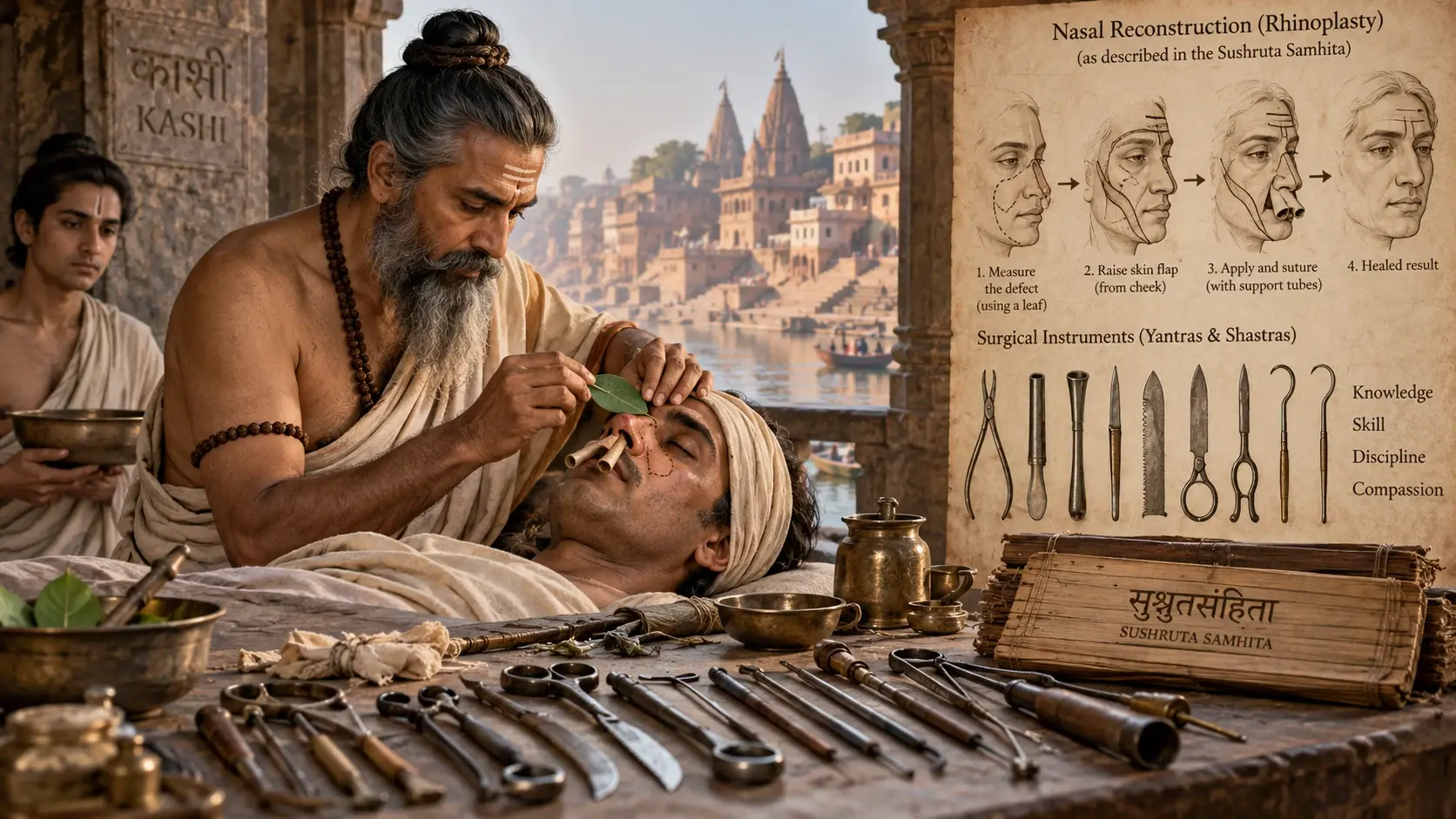
The *Sushruta Samhita* describes a remarkably systematic approach. The surgeon first used a leaf as a template, matching it to the size and shape of the missing portion of the nose. Tissue was then taken from the cheek and attached to the nasal defect. The margins were prepared and the reconstructed nose was supported during healing. Hollow tubes or reeds were inserted into the nostrils to help maintain the airway.
Principles of Reconstructive Surgery
Pre-Operative Template
Leaf Pattern Calibration: Measuring and contouring the defect precisely before making any surgical incision.
Autologous Tissue Transfer
Living Cheek Pedicle Flap: Harvesting tissue from adjacent anatomical region while maintaining pedicle attachment.
Vascular Viability
Preserving Blood Perfusion: Maintaining uninterrupted tissue connection to ensure survival until new vascularization.
Wound Bed Preparation
Scarification & Margins: Carefully scarifying the recipient bed to stimulate granulating apposition and healing.
Airway Stenting
Hollow Reeds / Tubes: Inserting hollow tubes into the nostrils during healing to preserve airway patency.
But Did Sushruta Invent the Forehead Flap?
This is where the popular version of the story needs correction. It is often stated that Sushruta invented the forehead flap rhinoplasty exactly as it is practiced today. The surviving description attributed to Sushruta, however, specifically describes taking a flap from the cheek.
The transition from the ancient cheek-flap technique to the forehead flap, which later became known as the “Indian method,” appears to have occurred within the subsequent Indian surgical tradition. The precise date of this transition is uncertain. This does not diminish Sushruta's achievement. Instead, it gives us a more accurate picture of how medical knowledge develops. The underlying principle—transferring living tissue while maintaining its connection to a blood supply—was preserved and modified over generations.
By the late eighteenth century, European observers encountered Indian practitioners performing nasal reconstruction using a forehead flap. Their reports helped bring the technique to European surgeons. In 1794, an account published in London's *Gentleman's Magazine* described the Indian method after British observers had witnessed a reconstruction in India. The English surgeon Joseph Carpue subsequently performed successful operations using the technique in 1814 and published his results in 1816.
Transmission Route of Nasal Reconstruction
c. 600 BCE
Ancient Indian Surgical Foundation
Sushruta preserves systematic cheek-flap pedicle rhinoplasty using leaf templates and reed airway stents in Kashi, establishing the first recorded autologous flap protocol.
Medieval Era
Transition to the Forehead Flap
Successive Indian surgical lineages adapt tissue transfer principles to the paramedian forehead flap, creating what later became globally celebrated as the “Indian Method”.
1794 CE
Gentleman’s Magazine Publication
British observers in Pune witness an Indian practitioner reconstruct a cart-driver's mutilated nose using a forehead flap, publishing an illustrated account in London.
1814–1816 CE
Joseph Carpue’s Operations
English surgeon Joseph Constantine Carpue successfully executes two forehead flap rhinoplasties in London and publishes his seminal surgical monograph.
Modern Era
Paramedian Forehead Flap Gold Standard
Modern plastic surgery recognizes the supratrochlear-artery-based paramedian forehead flap as the gold standard for nasal defect reconstruction, reflecting continuity with ancient principles.
The 121 Surgical Instruments: Yantras and Shastras
Perhaps the most remarkable evidence of Sushruta's systematic approach to surgery is his classification of instruments. The *Sushruta Samhita* describes 121 instruments, traditionally divided into two broad groups: **Yantras** (101 blunt instruments) and **Shastras** (20 sharp instruments).
Classification of the 101 Blunt Instruments (Yantras) in the Sushruta Samhita
Instrument Category
Count
Morphology & Classical Surgical Application
Svastika Yantra
24
Cruciform gripping forceps whose jaws resemble animal or bird heads (lions, tigers, wolves, crows, eagles); designed for extracting foreign bodies from bone and deep tissue.
Samdamsa Yantra
2
Pincer-like grasping devices (with and without locking catches) used for holding and extracting tissue or foreign bodies.
Tala Yantra
2
Scoop-like or paddle-shaped instruments used in specialized anatomical passages (ears, nostrils) for debris extraction.
Nadi Yantra
20
Tubular instruments, specula, cannulas, and catheters used for inspecting cavities, irrigating, and draining fluids.
Salaka Yantra
28
Slender rods, metallic probes, directors, and cautery points used for exploratory probing, medicated application, and thermal cautery.
Upayantra
25
Accessory surgical implements and support devices, including bandages, ligatures, cords, leather straps, splints, and mirrors.
Total Blunt Instruments
101
Complete catalogue of blunt mechanical instruments (Yantras).
Alongside them are 20 sharp instruments, giving the traditional total of 121: 101 + 20 = 121 instruments. The numerical classification is directly represented in the surgical-instrument chapters of the *Sushruta Samhita*. This is significant because Sushruta was not merely naming random tools. The text relates particular instruments to particular surgical tasks.
Yantras: The 101 Blunt Instruments
The first major category consists of Yantras, generally translated as blunt or non-cutting surgical instruments. The Svastika Yantras (24 varieties) were specialized gripping instruments. The text compares their jaws to the mouths or beaks of various animals and birds, including forms resembling lions, tigers, wolves, crows and other creatures. Their purpose was associated particularly with grasping and removing foreign bodies, including objects embedded in tissue or bone. The animal analogies are particularly interesting: they demonstrate that the design of an instrument was being understood in relation to function and shape.
Samdamsa instruments (2 varieties) were essentially pincer-like devices. Their function involved grasping or extracting material during surgical procedures. Although they should not simply be equated with modern forceps, their basic mechanical principle—gripping tissue or a foreign object—is immediately recognizable. Tala Yantras (2 varieties) formed another small group used in specialized procedures for extraction or cleaning in anatomical passages.
Nadi Yantras (20 varieties) were tubular instruments. The word nadi itself carries the sense of a tube or channel, and the instruments were used for examining or accessing bodily passages and cavities. This is one reason modern popular accounts sometimes compare them to primitive tubes, cannulas or specula. However, calling them “ancient endoscopes” would be an exaggeration. The principle of using a hollow instrument to access or examine a bodily passage is certainly present; modern optical endoscopy is technologically and conceptually much more sophisticated.
The Salaka group (28 varieties) consisted of slender rods or probes with a variety of applications, including probing, applying substances and performing procedures involving bodily channels and cautery. Their variety illustrates an important point: ancient surgical instruments were not necessarily designed as single-purpose tools. A skilled surgeon's knowledge determined how an instrument was used. The final group consisted of 25 Upayantras, or accessory instruments including cloth, cords, mirrors and other accessories, bringing the blunt total to 101.
The 20 Sharp Instruments (Shastras)
The second major category consists of 20 Shastras, or sharp surgical instruments. The *Sushruta Samhita* gives individual names and functions for these tools. Among them were instruments such as: **Mandalagra** (a rounded or circular-ended cutting instrument associated with incising and scraping); **Karapatra** (a saw-like instrument used for cutting bone); **Vriddhipatra** (a leaf-shaped cutting blade used for surgical incisions and excision); **Mudrika** (a ring-like cutting instrument for tight or deep spaces); and **Suchi** (needle-like instruments used particularly for suturing).
The text also includes instruments such as *Nakha-shastra, Utpalapatra, Ardhadhara, Kushapatra, Trikurchaka, Kutharika, Vrihimukha, Ara, Vetasa-patra, Badisha, Danta-shanku* and *Eshani*. The terminology is important because it reminds us that translating an ancient instrument directly into a modern medical device can sometimes create a false equivalence. A better approach is to explain what the ancient text says the instrument did and then, where useful, compare its general principle with a modern tool.
Eight Basic Forms of Surgery: Ashtavidha Shastra Karma
Sushruta also classified surgical operations into eight fundamental forms, traditionally known as **Ashtavidha Shastra Karma**. These were not simply theoretical categories; the text associates particular operations with specific clinical conditions.
Ashtavidha Shastra Karma: Eightfold Classification of Operative Surgery in the Sushruta Samhita
Sanskrit Term
General Meaning
Broad Modern Comparison
Clinical Indications in Sushruta Samhita
Chedana
Excision / cutting away
Surgical excision of tissue
Excision of tumors, necrotic margins, infected tissue, piles, fistula tracts
Bhedana
Incision / opening
Incision and decompression
Opening deep abscesses, boils, cysts, hydrocele, abdominal fluid pockets
Apposing surgical incisions and lacerations using fine needles and biological threads
Bladder-Stone Surgery: Ancient Vesicolithotomy
The *Sushruta Samhita* contains detailed descriptions of the treatment of urinary stones. The surgical treatment involved positioning the patient, locating the stone through perineal manipulation, and extracting it through an operative procedure. Historical studies of the text identify this as an important early account of vesicolithotomy, or surgical removal of bladder stones.
This should not be confused with modern minimally invasive stone surgery. The procedure was performed without modern anesthesia, antisepsis, imaging or antibiotics and therefore carried substantial risks. Nevertheless, the description demonstrates that ancient Indian surgeons were attempting to treat serious internal conditions through deliberate operative intervention.
Cataract Surgery: What Does the Evidence Actually Say?
Sushruta is also frequently credited with inventing cataract surgery. The *Sushruta Samhita* does contain an ancient description of a procedure for cataract-like conditions involving an instrument introduced into the eye. Modern historians of ophthalmology, however, disagree about exactly how the procedure should be classified.
Some studies interpret Sushruta's description as a form of couching, in which the opaque lens is displaced away from the visual axis. Other scholarship has argued that the description may include a procedure involving the expulsion of liquefied lens material through a small puncture. The important point is that this was not modern cataract extraction. Modern cataract surgery bears little technological resemblance to the ancient procedure.
Surgery Had to Be Practised Before Operating on People
Perhaps one of the most striking aspects of the *Sushruta Samhita* is its emphasis on practical surgical education. Students were not expected to learn surgery merely by reading. They were instructed to practice techniques on models and natural materials that approximated particular tissues or procedures.
Simulation-Based Surgical Training in Ancient Kashi
Incisions & Excisions (Chedana/Bhedana)
Gourds, Cucumbers, Watermelons: Practicing blade depth control, straight and curved incisions on vegetable flesh.
Puncture & Fluid Release (Vyadhana/Visravana)
Fluid-Filled Leather Bags & Animal Bladders: Simulating cyst and abscess decompression without rupturing organ walls.
Scarification & Scraping (Lekhana)
Hairy Animal Hides: Practicing superficial debridement and hair removal without cutting underlying dermis.
Thick Cloth, Fine Canvas & Leathers: Mastering needle passage, stitch pitch, and tensioning prior to operating on human skin.
This resembles what modern medical education would call simulation-based training. The comparison should not be pushed too far—the materials and knowledge were obviously very different—but the educational principle is striking: *Practice the movement before performing it on a patient.*
Anatomy Through Dissection
Sushruta's surgical education also included anatomical study. Historical discussions of the text describe a method in which a cadaver was prepared and immersed in running water for a period of time so that tissues could gradually decompose, allowing students to examine the body layer by layer using soft brushes made of roots and fibres.
This is especially significant because effective surgery requires more than knowing the names of diseases. A surgeon needs to understand the position of organs, the relationship between tissues, blood vessels, bones, muscles, vital anatomical junctions (*Marmas*), and the consequences of cutting too deeply. The surgical tradition associated with Sushruta therefore linked anatomical observation with practical operative training.
A Surgeon Was Expected to Be More Than Technically Skilled
The *Sushruta Samhita* also contains a strong conception of professional responsibility. The text warns against surgical mistakes caused by lack of knowledge, insufficient skill, haste, fear, nervousness or other failures of judgment. It also emphasizes the responsibility of the physician toward the patient.
“The physician should protect and nurture the patient with the same dedication, vigilance and tenderness as one would protect one’s own child.”
Sushruta Samhita — Sutra Sthana (Chapter on the Medical Oath & Duty)
This reveals an important dimension of the text that is often lost when Sushruta is reduced to a list of inventions. He was not describing surgery merely as a collection of mechanical operations. He was describing a profession with technical, educational and ethical obligations.
From Kashi to the History of Global Surgery
The significance of Sushruta extends beyond the history of India. The nasal reconstruction tradition associated with the *Sushruta Samhita* eventually became connected with the “Indian method” of rhinoplasty known to European surgeons. The procedure attracted renewed European attention in the late eighteenth century after reports from India were published in European medical and general-interest publications. Joseph Carpue's successful operations in 1814 and their publication in 1816 helped establish the technique within European surgical circles.
The story is therefore not simply one of an ancient invention disappearing and suddenly being “rediscovered.” It is better understood as a long transmission of surgical knowledge, in which techniques were preserved, modified and transmitted through different communities and periods.
What Makes Sushruta’s Legacy Extraordinary?
The most remarkable aspect of Sushruta's legacy is not one isolated invention. It is the system. The tradition associated with him brought together: **Anatomy → instruments → surgical classification → practical training → operative technique → wound management → postoperative care → professional responsibility**.
His nasal reconstruction demonstrates an understanding of tissue transfer. His instrument catalogue demonstrates systematic classification. His surgical training demonstrates the value of practical simulation. His anatomical teachings demonstrate the importance of understanding the body before operating on it. His descriptions of wounds, stones and eye disorders demonstrate a willingness to treat difficult conditions through intervention. Taken together, these elements show a surgical tradition considerably more systematic than the simplistic image of an ancient healer with a knife.
What We Should—and Should Not—Claim About Sushruta
Historical writing about ancient medicine requires particular care. It is reasonable to say that the *Sushruta Samhita* preserves one of the world's earliest detailed traditions of surgery and that its nasal-reconstruction techniques are historically important to the development of reconstructive surgery. It is also reasonable to discuss the text's 121 instruments, eight surgical procedures, anatomical study and practical training.
Distinguishing Rigorous History from Popular Exaggerations
Rigorous Historical Record
Reconstructive Surgery:Described cheek-flap pedicle tissue transfer with leaf templates and airway stenting.
Surgical Instrumentation:Systematic classification of 121 instruments (101 Yantras, 20 Shastras) designed for specific procedures.
Ophthalmic Surgery:Earliest documented Indian operative intervention for cataract, likely couching / displacement.
Reconstructive Surgery:Claiming Sushruta performed modern paramedian forehead flap rhinoplasty identically.
Surgical Instrumentation:Calling ancient hollow tubes (Nadi Yantras) "fiber-optic endoscopes" or equating them to modern robotic tools.
Ophthalmic Surgery:Claiming ancient surgeons invented modern phacoemulsification or intraocular lens implantation.
Anesthesia & Germ Theory:Asserting ancient India possessed modern inhalation anesthesia, antiseptic germ theory, and antibiotics.
Ancient surgery was operating without modern anesthesia, antibiotics, antisepsis, imaging, blood transfusion or modern understanding of infection and physiology. Its achievements become more impressive—not less impressive—when understood within those historical limitations.
Conclusion: The Surgeon Behind the Legend
More than two millennia ago, the surgical tradition associated with Sushruta attempted something remarkably ambitious: it sought to transform surgery from an improvised craft into a systematic discipline. Its practitioners catalogued instruments, classified operations, studied anatomy, practised techniques on models, treated wounds and stones, attempted eye surgery and developed methods for reconstructing damaged faces.
The *Sushruta Samhita* even preserved detailed descriptions of 121 surgical instruments, including 101 blunt instruments and 20 sharp ones. And in its account of nasal reconstruction, it preserved one of the most important early chapters in the history of reconstructive surgery.
The most enduring lesson is therefore not that ancient India somehow possessed modern medicine thousands of years early. It is something more historically meaningful: Sushruta and the surgical tradition associated with him demonstrate that sophisticated observation, practical experimentation, disciplined training and careful classification were already being applied to surgery in ancient South Asia. The legend of the “Father of Surgery” is powerful. But the historical record is powerful enough on its own.
Scholarly Frequently Asked Questions
Did Sushruta invent modern plastic surgery?▼
Sushruta is celebrated as a pioneer of reconstructive surgery because the Sushruta Samhita contains the earliest detailed description of nasal reconstruction using living pedicle flaps, pre-measured templates, and airway stents. However, modern plastic surgery is built on microsurgical vascular repair, modern sterile antisepsis, general anesthesia, and modern tissue physics, which developed centuries later.
Did Sushruta invent the forehead flap rhinoplasty?▼
The surviving text of the Sushruta Samhita specifically describes harvesting a pedicle flap from the cheek. The transition from cheek flap to paramedian forehead flap developed later within the Indian surgical lineage. It was this later technique that British observers documented in 1794 in the Gentleman’s Magazine, and which Joseph Carpue introduced to European surgery in 1814.
What are the 121 instruments described in the Sushruta Samhita?▼
The text catalogs 101 blunt instruments (Yantras) and 20 sharp instruments (Shastras). The blunt group includes 24 Svastika (gripping forceps modeled after animal and bird jaws), 2 Samdamsa (pincers), 2 Tala (scoops), 20 Nadi (tubular specula and cannulas), 28 Salaka (probes and cautery rods), and 25 Upayantras (accessory supports). The 20 sharp instruments include surgical knives, saws, trocars, needles, and lancets.
How did ancient surgical students practice before operating on live humans?▼
The Sushruta Samhita mandated simulation-based training. Students practiced incisions and excisions on gourds and cucumbers; puncture and fluid drainage on liquid-filled animal bladders; scraping on hairy hides; probing on hollow reeds and worm-eaten wood; and suturing on tanned leather and canvas.