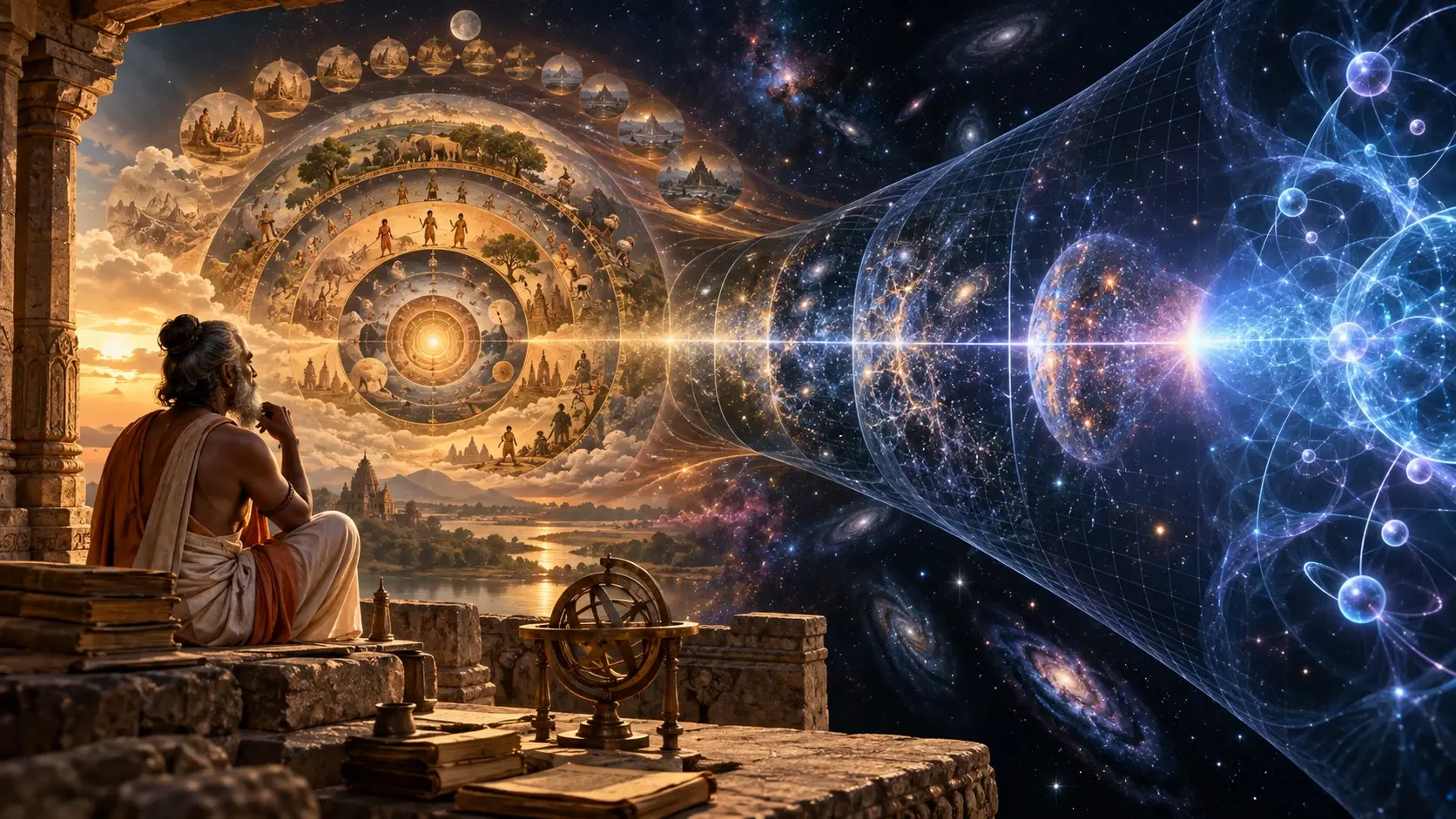
From Kalpas to Quantum Fluctuations: Cosmic Time in Indian Philosophy
From the billions of years of Puranic cosmology to the fleeting kṣaṇa of Buddhist philosophy, Indian traditions developed extraordinary ways of thinking about time, creation and cosmic change.
Indian philosophy developed remarkably large and small scales of time, from Puranic kalpas lasting billions of years to the Buddhist doctrine of momentariness. When these ideas are compared with quantum fluctuations, relativity and modern cosmology, the most fascinating parallels emerge—not as predictions of modern physics, but as different approaches to humanity's oldest questions about time and the origin of the universe.
Aakash Bhagat
Founder & Editor
•Updated September 9, 2026•14 min read
Cosmic time, cyclical manifestation, and philosophical reflections on time from the Puranas to Buddhist momentariness and modern physics.Archaeological Archives
Atop the sacred Sivagiri hill in Palani, Tamil Nadu, stands an ancient idol crafted not from stone or bronze, but from Navapashanam—an alchemical matrix of nine deadly poisons solidified by Sage Bogar. Discover the hidden chemistry, the healing powers of the overnight sandal paste and abhishekam prasadam, the subterranean tunnel connecting Bogar's samadhi, and the controversial 2004 replacement that triggered an international antiquities investigation.
High in eastern Turkey’s Tendürek Mountains, a 515-foot boat-shaped formation has puzzled researchers for 65 years. In September 2026, university archaeologists began direct core drilling for the first time since 1988. Discover what was actually recovered, how Collins and Fasold exposed early claims, and the falsifiable test awaiting 2027 lab results.
Coorg's hillside resorts book out months in advance now. Gokarna's main beach can feel more like a queue than a shoreline, and Hampi comes with tour buses in equal measure. But Karnataka's Malnad hill country and coastal belt hold a genuinely different kind of trip: rainforest instead of resort, empty tide lines instead of beach shacks, and moss-draped forts you'll have mostly to yourself. Discover 7 secret places in Karnataka that redefine South Indian travel.
Indian philosophical traditions developed some of the most elaborate reflections on time, change, creation and dissolution in the premodern world. Their scales range from the vast cycles of yugas and kalpas to the fleeting kṣaṇa of Buddhist philosophy.
It is tempting to draw a straight line from these ideas to modern cosmology—to compare a kalpa with the age of Earth, truti with Planck time, or the Nasadiya Sukta with quantum cosmology. But those comparisons require care.
This distinction allows the remarkable ideas of Indian cosmology to be appreciated without turning modern physics into a retrospective confirmation of ancient scripture.
The Macro-Cosmic Scale: Yugas, Kalpas and the Cycles of Time
One of the most striking features of classical Hindu cosmology is its enormous conception of time. In many Puranic cosmological systems, time is not a straight line beginning at a single creation event. It is structured through recurring cycles of creation, preservation, dissolution and renewed manifestation.
The Classical Mahāyuga Cycle and Traditional Time Spans
Yuga (Epoch)
Divine Years
Conversion Multiplier
Human Solar Years
Satya / Kṛta Yuga
4,800
× 360
1,728,000
Tretā Yuga
3,600
× 360
1,296,000
Dvāpara Yuga
2,400
× 360
864,000
Kali Yuga
1,200
× 360
432,000
Total Mahāyuga
12,000
× 360
4,320,000
A thousand Mahāyugas constitute a day of Brahmā, commonly called a **kalpa**: 1,000 × 4.32 million = **4.32 billion human years**. The corresponding night of Brahmā is traditionally of equal duration, producing an entire day-night cycle of 8.64 billion years. Brahmā's lifespan is calculated as 100 such years, yielding approximately **311.04 trillion human years**.
Cosmic Chronologies Compared: Kalpas vs Modern Geochronology
Duration of One Kalpa (Puranas)
4,320,000,000 years (4.32 billion years)
Radiometric Age of Planet Earth
4,540,000,000 years (4.54 billion years ± 1%)
Current Age of the Observable Universe
13,787,000,000 years (13.78 billion years)
Lifespan of Brahmā (Maha-Kalpa)
311,040,000,000,000 years (311.04 trillion years)
Traditional Divine Year Conversion
1 Divine Year = 360 Human Solar Years
Time Was Not Simply "Linear vs Cyclical"
It is also too simple to say that Indian philosophy believed exclusively in cyclical time while modern science believes in linear time. Different Indian traditions developed fundamentally different models: Puranic cosmology emphasizes recurring cosmic cycles; Sāṅkhya describes processes of manifestation and reabsorption through the interplay of prakṛti and puruṣa; Buddhist philosophy emphasizes impermanence and moment-to-moment arising; and Advaita Vedānta distinguishes the empirical domain from the timeless reality of Brahman.
From the Largest Scale to the Smallest Moment: Kṣaṇa
If Puranic cosmology imagined time on a scale of billions and trillions of years, other Indian traditions investigated the opposite extreme: the fleeting instant. In Buddhist philosophy, the doctrine of **kṣaṇavāda** (momentariness) holds that conditioned phenomena do not persist unchanged through time; rather, phenomena arise, undergo change and cease in discrete momentary events.
The Buddhist kṣaṇa is primarily part of a metaphysical analysis of impermanence and dependent origination (pratītyasamutpāda). It is not an ancient physical measurement equivalent to a femtosecond or Planck time. Conflating metaphysical momentariness with subatomic chronometry creates a serious category error.
Paramāṇu Was Not the Ancient Indian Version of Planck Time
Another frequently repeated claim concerns the Sanskrit terms *paramāṇu* and *truṭi*. They are sometimes presented online as if Indian philosophers had discovered the modern subatomic particle and Planck time.
In Vaiśeṣika philosophy, *paramāṇu* refers to an indivisible fundamental particle in an atomistic theory of matter, not a unit of spacetime. The term *truṭi*, meanwhile, appears in several classical traditions with conflicting numerical definitions—the system in the *Bhāgavata Purāṇa* differs significantly from Kauṭilya's *Arthaśāstra*. Therefore: **Paramāṇu ≠ Planck scale**, and **Truṭi ≠ Planck time**.
The Nāsadīya Sūkta: When Creation Itself Becomes a Question
Perhaps the most fascinating ancient Indian text for discussions of cosmic origins is Ṛgveda 10.129, traditionally known as the **Nāsadīya Sūkta**, or "Hymn of Creation." Its importance lies precisely in the fact that it does not provide a simplistic dogma or mythic creation story.
“There was neither non-existence nor existence then; there was neither the realm of space nor the sky beyond. What stirred? Where? In whose protection? Was there water, bottomlessly deep?”
Ṛgveda 10.129 (Nāsadīya Sūkta) — Opening Verse of the Hymn of Creation
The hymn introduces darkness, an undifferentiated primordial condition, and *kāma* (primal desire) as an early catalyst for manifestation. But its most radical insight arrives in its conclusion: the poet asks who actually knows how creation arose, noting that the gods themselves were born after creation. The hymn leaves open the extraordinary possibility that even the supreme overseer in highest heaven may not know.
Did the Nāsadīya Sūkta Describe the "Quantum Vacuum"?
Not literally. In modern quantum field theory, the "vacuum state" is not absolute philosophical nothingness. It is the lowest-energy state of physical fields, permeated by measurable zero-point quantum fluctuations. Vedic non-existence (*asat*) is a metaphysical concept, while the quantum vacuum is a mathematically defined physical state with measurable consequences like the Casimir effect.
Quantum Fluctuations and the Early Universe
Modern cosmology does, however, contain an extraordinary story involving quantum fluctuations. According to cosmic inflation, the early universe underwent a period of exponential expansion within fractions of a second after the singularity.
During inflation, microscopic quantum fluctuations in the inflaton field were stretched across macroscopic cosmological distances. These fluctuations created tiny density differences in the primordial plasma, preserved as temperature variations in the Cosmic Microwave Background (CMB) observed by satellites like WMAP and Planck. Over billions of years, gravity pulled matter into these denser ripples, forming galaxies, stars, and planets.
What About "Spanda"—the Cosmic Vibration?
In Kashmir Shaivism, particularly the Spanda tradition, *spanda* refers to the divine, dynamic pulsation or throbbing of pure consciousness (Śakti). The philosophical concept is that ultimate reality is not static and inert, but an ecstatic, self-luminous vibration of awareness.
While this offers a poetic comparison with quantum field excitations or string theory vibrations, *spanda* is a non-dual metaphysical doctrine of consciousness, not a physical vibration of electromagnetic or gravitational fields.
Sāṅkhya and the Unmanifest Prakṛti
A more defensible philosophical comparison can be found in Sāṅkhya. Classical Sāṅkhya distinguishes between **Puruṣa** (the witnessing consciousness) and **Prakṛti** (primordial nature). In its unmanifest state (**Avyakta**), Prakṛti exists as a balanced equilibrium of three fundamental qualities (*guṇas*: sattva, rajas, tamas). When this equilibrium is disturbed, the manifest cosmos (*Vyakta*) evolves.
This provides an intriguing conceptual parallel to physical ideas of symmetry breaking and potentiality preceding manifestation, but it remains a metaphysical framework rather than a mathematical quantum theory.
Time, Consciousness and Einsteinian Relativity
Popular accounts frequently assert that "both Indian philosophy and Einstein proved that time is an illusion created by consciousness." This conflates two completely different ideas.
Einstein's Theory of Relativity showed that time is relative to an observer's **physical state of motion and gravitational potential**. An atomic clock aboard a high-speed satellite ticks slower relative to a ground station clock whether a human is looking at it or not. Relativity does not require human consciousness to alter spacetime.
In Advaita Vedānta, time (*kāla*) belongs to the empirical realm (*vyavahāra*), whereas ultimate reality (*paramārtha*) is Brahman—timeless, non-dual, and beyond causality. Comparing the two is valuable not because they say the same thing, but because both challenge the common-sense intuition that time is an absolute, rigid background unaffected by deeper reality.
One Universe or Endless Cycles?
Contrasting Cosmological Paradigms
Classical Indian Traditions
Temporal Geometry:Endless recurring cycles of manifestation (Sṛṣṭi) and dissolution (Pralaya).
Measurement Scale:Yugas (432,000 to 1,728,000 yrs), Kalpas (4.32B yrs), and Maha-Kalpas (311.04T yrs).
Dissolution Model:Periodic cosmic reabsorption into unmanifest Prakṛti or divine rest.
Underlying Epistemology:Metaphysical reasoning, contemplative introspection, and textual debate.
Modern Standard Cosmology
Temporal Geometry:Observable universe with a hot, dense early state 13.8 billion years ago; open expansion.
Measurement Scale:Seconds, atomic clocks, light-years, and radiometric isotope dating.
Dissolution Model:Thermodynamic heat death, Big Freeze, or asymptotic cosmic dilution.
Underlying Epistemology:Mathematical modeling, astronomical observations, and falsifiable experiments.
Editorial Fact-Check: What Can Actually Be Claimed?
Rigorous Fact-Check: Popular Claims vs. Evidence-Based Assessment
Popular Internet Claim
Scholarly & Scientific Assessment
Verdict
A Kalpa lasts 4.32 billion years
Accurately represents the traditional Puranic calculation (1,000 Mahāyugas × 4.32M years).
Historical Fact
A Kalpa was a scientific calculation of Earth’s age
The Kalpa is a metaphysical cycle in sacred cosmology; geological age (~4.54B yrs) is determined by radiometric decay.
False Equivalence
Buddhist Kṣaṇa is the ancient equivalent of Planck time
Kṣaṇavāda is a metaphysical theory of impermanence and causation, not a physical unit of time.
Unsubstantiated
Paramāṇu is the ancient Indian Planck scale
Vaiśeṣika paramāṇu is an indivisible material particle in early atomism, not a relativistic spacetime metric.
False Equivalence
The Nāsadīya Sūkta describes the Big Bang
The hymn is an epistemic meditation on the limits of origins, not an astrophysical inflationary model.
Unsubstantiated
Vedic non-existence (Asat) is the Quantum Vacuum
Quantum vacuum is a physical state with field energy and zero-point fluctuations, not metaphysical non-being.
Spanda is the metaphysical pulsation of consciousness in Kashmir Shaivism, not a quantum harmonic oscillator.
Poetic Analogy Only
Einstein proved time depends on human consciousness
Relativity makes time dependent on physical reference frames and gravity, completely independent of minds.
False
Conclusion: Two Different Languages for an Ancient Question
From the enormous cycles of the kalpa to the fleeting kṣaṇa, Indian philosophical traditions developed an extraordinary vocabulary for thinking about time. The Puranic imagination stretched cosmic chronology across billions and trillions of years; Buddhist thinkers analyzed existence into momentary processes; Sāṅkhya explored unmanifest nature; and the Nāsadīya Sūkta transformed the origin of the cosmos into a question about the limits of knowledge itself.
Modern physics approaches some of the same ultimate questions from an entirely different direction, utilizing relativity, quantum fields, and observational astronomy. The parallels are fascinating—not because ancient Indian thinkers formulated modern physics, but because both reveal that common-sense human intuition is poorly equipped to comprehend the deepest scales of reality.
“How did existence arise—and can anyone truly know? The ancient Vedic poets posed the question with epistemic humility; modern cosmology is still seeking the answer.”
Beyond Bharat Editorial Team — Cosmic Scales in Indian Philosophy
Scholarly Frequently Asked Questions
Did ancient Indian astronomers calculate the age of the Earth as 4.32 billion years?▼
No. The 4.32-billion-year figure is the duration of a Kalpa (a Day of Brahmā), derived from multiplying 1,000 Mahāyugas of 4.32 million years each in Puranic sacred chronology. While close in magnitude to Earth’s radiometric age of 4.54 billion years, it was arrived at through metaphysical and calendrical mathematics, not geological or empirical dating.
What is the Buddhist concept of Kṣaṇa, and is it related to Planck time?▼
Kṣaṇa is the Buddhist concept of an instantaneous moment within the doctrine of momentariness (kṣaṇavāda). It asserts that all conditioned phenomena arise and perish continuously. It is a philosophical analysis of impermanence and causation, not a physical measurement like Planck time (5.39 × 10⁻⁴⁴ s), which is derived from physical constants.
Does the Nāsadīya Sūkta predict modern Big Bang cosmology?▼
The Nāsadīya Sūkta (Ṛgveda 10.129) is a profound contemplative hymn exploring the paradoxes of pre-cosmic existence and non-existence, concluding with radical epistemic humility about whether even the gods know how creation arose. It is a philosophical meditation on origins, not an astrophysical prediction of the Big Bang.
Did Einstein say that time is created by human consciousness?▼
No. Einstein’s theory of relativity demonstrated that time measurements vary based on the physical velocity of an observer’s reference frame and the curvature of spacetime around mass. This is an objective physical phenomenon verified by atomic clocks, not a claim that human consciousness generates time.