Stone Age Delhi: What a Row of Cup-Marks on the Central Ridge Reveals
An unexpected discovery of cupules and ladder-like carvings on Delhi’s Central Ridge — combined with Mangar Bani’s Acheulian factory — reveals that prehistoric humans walked the Aravalli hills millennia before imperial capitals rose.
When naturalist Pradip Krishen and researcher Chetan Agrawal spotted a row of seven cupules and ladder-like figures etched into quartzite rock near the Delhi Polo Ground, they uncovered the first recorded rock art inside Delhi’s Central Ridge. Together with Mangar Bani’s Lower Paleolithic tools, a profound story of deep human antiquity emerges.
Aakash Bhagat
Founder & Editor
•Updated September 23, 2026•7 min read
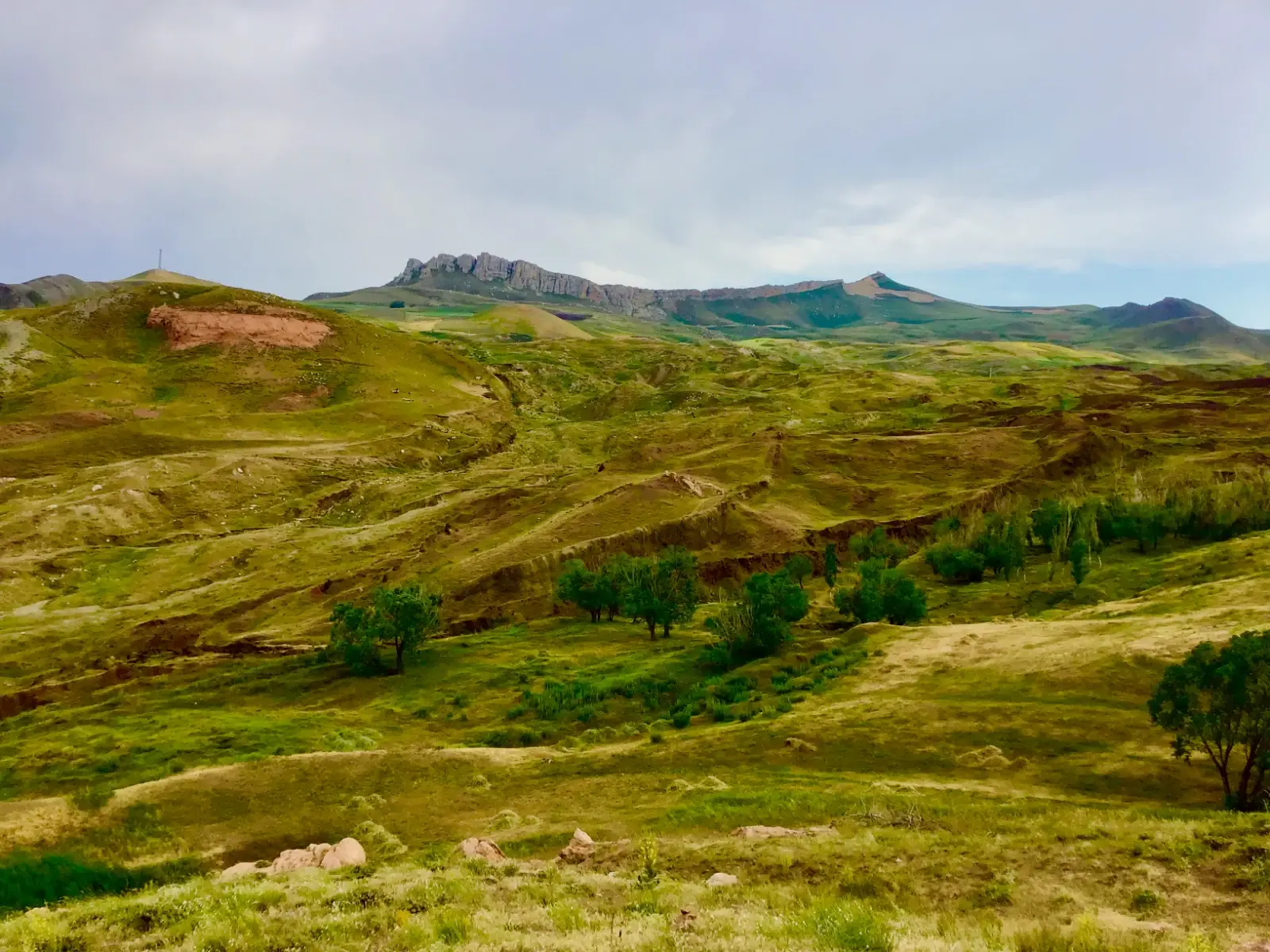
Ancient quartzite outcrops of the Aravalli Range on Delhi’s Central Ridge, where cupule depressions and geometric petroglyphs were recently documented.Archaeological Archives
High in eastern Turkey’s Tendürek Mountains, a 515-foot boat-shaped formation has puzzled researchers for 65 years. In September 2026, university archaeologists began direct core drilling for the first time since 1988. Discover what was actually recovered, how Collins and Fasold exposed early claims, and the falsifiable test awaiting 2027 lab results.
Atop the sacred Sivagiri hill in Palani, Tamil Nadu, stands an ancient idol crafted not from stone or bronze, but from Navapashanam—an alchemical matrix of nine deadly poisons solidified by Sage Bogar. Discover the hidden chemistry, the healing powers of the overnight sandal paste and abhishekam prasadam, the subterranean tunnel connecting Bogar's samadhi, and the controversial 2004 replacement that triggered an international antiquities investigation.
Coorg's hillside resorts book out months in advance now. Gokarna's main beach can feel more like a queue than a shoreline, and Hampi comes with tour buses in equal measure. But Karnataka's Malnad hill country and coastal belt hold a genuinely different kind of trip: rainforest instead of resort, empty tide lines instead of beach shacks, and moss-draped forts you'll have mostly to yourself. Discover 7 secret places in Karnataka that redefine South Indian travel.
Whether you crave snowy Himalayan walks, candlelit palace reflections across Lake Pichola, high-energy beach parties in Goa, colonial carnival effigies in Fort Kochi, or tropical isolation in the Andamans, India offers an astonishing spectrum of year-end celebrations. Discover five magical destinations to spend Christmas and New Year.
Sometime in mid-2026, the naturalist and writer Pradip Krishen was doing what he had done countless times before — walking the Central Ridge forest near the Delhi Polo Ground, tracking the seasonal change of the biocrusts (the thin living skins of moss, algae, and lichen that colonise bare soil) he had been quietly observing for years. He had visited this particular outcrop of quartzite rock many times. What changed this visit was who he brought along: the environmental researcher Chetan Agrawal, who had spent years documenting similar markings in the Haryana Aravalli hills and recognised something Krishen, by his own account, had simply walked past.
What Was Actually Found
The markings on the rock resolve into two distinct patterns. One is a row of seven or eight cup-like depressions — cupules — arranged in a parallel line. The other is a pair of ladder-like figures set at right angles to each other. Krishen, who has been candid in interviews about not being a rock-art specialist, has been careful not to speculate on their age, though he has noted the choice of surface is itself suggestive: quartzite is an exceptionally hard, slow-weathering rock, which is precisely why marks cut into it millennia ago can still be legible today.
What can be said with more confidence is the discovery’s significance for Delhi specifically: this is the first time petroglyphs of this kind have been documented inside the Central Ridge. Isolated prehistoric stone tools had previously turned up further north, around the Kamla Nehru Ridge and the Jawaharlal Nehru University campus, but rock art itself — carved symbols rather than worked tools — had never been recorded within the Ridge’s boundaries before.
Discovery Dossier: Central Ridge Petroglyphs
Site Location
Central Ridge Forest (nr. Delhi Polo Ground)
Host Rock
Precambrian Aravalli Quartzite Outcrop
Petroglyph Typology
Parallel Cupules & Orthogonal Ladder Figures
First Documented By
Pradip Krishen & Chetan Agrawal
Comparative Delhi Site
Ashoka Minor Rock Edict (East of Kailash)
Regional Paleolithic Link
Mangar Bani Acheulian Complex (Faridabad)
There is also a striking follow-up thread worth noting: researchers at Ashoka University, Malavika Chatterjee and Akash Srinivas, had separately noticed similar cupule marks on the rock bearing one of Emperor Ashoka’s own edicts elsewhere in Delhi — markings that had been noted decades earlier by the epigrapher Harry Falk but not fully investigated. Following Krishen’s discovery, rock-art specialist Neelam Singh of the Indian Institute of Heritage examined and digitally enhanced the Ashokan rock’s cupules, raising the genuinely provocative possibility that some of Delhi’s cup-marks may predate the third-century-BCE emperor’s inscription entirely — cut into the stone long before anyone thought to carve an imperial edict on it.
“Some of Delhi’s cup-marks may predate the third-century-BCE emperor’s inscription entirely — cut into the stone long before anyone thought to carve an imperial edict on it.”
Archaeological & Epigraphic Re-examination — Indian Institute of Heritage & Ashoka University
Mangar Bani: An Earlier, Related Discovery
It is tempting to treat the Aravalli site of Mangar Bani, just across Delhi’s southern border toward Faridabad and Gurugram, as a second recent discovery running in parallel with the Central Ridge find. That is not quite the timeline, and getting it right matters for understanding how these two stories actually relate to each other.
The ancient quartzite formations of the Aravalli hills, whose weathering and mineral hardness preserved prehistoric tools and shelter art for hundreds of millennia.Photo: Ecological & Geological Survey Archive
Mangar Bani’s significance first came to public attention in May 2021, when the local environmental activist Sunil Harsana — a Mangar Bani resident who had spent over a decade working to protect the forest from mining and encroachment — came across cave paintings and rock art in a part of the forest he knew intimately but had never examined with an archaeologist’s eye. Haryana’s Department of Archaeology and Museums confirmed the find shortly afterward: rock shelters in the Damdama, Shilakheri, Mangar, and Dhauj areas containing paintings alongside pebble, core, and flake-based stone tools belonging to the Acheulian tradition — one of the oldest recognised standardised toolmaking traditions anywhere. Banani Bhattacharyya, then deputy director of Haryana’s archaeology department, described the find as potentially one of the largest Paleolithic sites in the Indian subcontinent.
The "stone tool factory" framing comes from a later, more intensive phase of work: a 2025 excavation led by former ASI Joint Director-General S.B. Ota, which in under a week recovered over 200 tools — handaxes, cleavers, and scrapers among them — along forest trails and exposed rock patches, with daily finds running as high as 30 to 80 artefacts. It was this excavation that produced the "factory site" language: Ota’s assessment, echoed by ASI’s Nandini Bhattacharya Sahu, was that the freshness of the tools and the presence of local raw quartzite and sandstone material indicated the tools were manufactured on-site, not merely used in transit — evidence of sustained hominin habitation and systematic lithic knapping.
The cave paintings Harsana found are a genuinely separate line of evidence from the stone tools, both in kind and in date: they are generally placed in the Upper Palaeolithic range, roughly 20,000 to 40,000 years before present — tens of thousands of years more recent than the Acheulian tool-making phase, representing a much later, though still extraordinarily ancient, chapter of the same site’s human presence.
Chronological Horizon of the Delhi-Aravalli Landscape
c. 500,000 – 200,000 BP
Lower Paleolithic Acheulian "Factory"
Early hominins craft standardized quartzite handaxes, cleavers, and flaked cores in the Mangar Bani riverine forests.
c. 40,000 – 20,000 BP
Upper Paleolithic Rock Paintings
Hunter-gatherers produce ochre cave paintings across Aravalli overhangs in Damdama, Shilakheri, and Mangar.
Prehistoric / Undated
Central Ridge Cupules & Petroglyphs
Ancestral inhabitants carve parallel cupules and geometric ladder forms into the exposed Central Ridge quartzite.
c. 250 BCE
Mauryan Epigraphical Engraving
Artisans of Emperor Ashoka carve a Minor Rock Edict onto a Delhi boulder that already bore ancient, pecked cupule marks.
Two Discoveries, One Larger Picture
Even correcting the timeline, the throughline connecting these finds is real and worth making explicit: the Delhi-NCR region’s underlying geology — the Aravalli Range’s ancient quartzite, among the oldest exposed rock in India, predating the Himalayas by a wide margin — has apparently been continuously significant to human and hominin populations for an extraordinary span of time, from Acheulian toolmakers several hundred thousand years ago through Upper Palaeolithic painters tens of thousands of years back, and, if the Central Ridge markings do turn out to be genuinely ancient once formally dated, potentially connecting into a documented human presence stretching into recorded history through the Ashokan-era rock nearby.
Comparative Archaeology: Central Ridge vs. Mangar Bani
Central Ridge (Delhi)
Geographic Context:Urban Central Ridge forest near Delhi Polo Ground
Primary Find:7–8 aligned cupules and perpendicular ladder motifs
Significance for Region:First petroglyphs ever confirmed inside Delhi Central Ridge
Nature of Discovery:Naturalist tracking soil biocrusts (P. Krishen & C. Agrawal)
Mangar Bani (Faridabad / Gurugram)
Geographic Context:Sacred grove & Aravalli buffer zone in Haryana
Primary Find:200+ Acheulian stone tools & rock shelter paintings
Estimated Age:Tools: 200k–500k BP; Paintings: 20k–40k BP
Significance for Region:Massive Lower Paleolithic manufacturing site in NCR
Nature of Discovery:Community activist defending forest from mining (S. Harsana)
None of this is yet fully resolved. The Central Ridge carvings await proper scientific dating — Krishen himself has been the first to say so — and Mangar Bani’s cave paintings, more than four years after their discovery, are still awaiting the carbon dating and accelerator mass spectrometry analysis that would move their age from informed estimate to confirmed fact. What both stories share, though, is a common origin that says something about how discovery actually happens in a landscape as heavily used and overlooked as the Delhi Ridge and the Aravalli fringe: neither find came from a targeted archaeological survey. One came from someone studying biocrust, the other from a conservationist protecting a forest for entirely different reasons. Looking closely at ordinary ground, it turns out, is sometimes how you find the oldest things in it.
Scholarly Frequently Asked Questions
What are cupules and why are they considered rock art?▼
Cupules are non-utilitarian, circular, cup-shaped hollows pecked or ground into rock surfaces by ancestral humans. Documented globally from the Lower Paleolithic onward, they represent one of humankind’s earliest and most widespread forms of symbolic or cultural marking.
How old are the Central Ridge cup-marks?▼
Formal chronometry (such as optical stimulated luminescence of overlaying sediments or micro-erosion testing) has not yet been completed. Researchers are exercising caution, though the presence of similar marks on an Ashokan edict rock in Delhi strongly suggests they predate the 3rd century BCE.
Did archaeologists find Homo erectus skeletons at Mangar Bani?▼
No skeletal fossils have been unearthed. The attribution to Homo erectus is a typological inference based on the distinctive Acheulian handaxe manufacturing technique, which is universally correlated with Homo erectus and archaic Homo sapiens in South Asia.
Explore Related Inquiries into Indian Archaeology & Antiquity